
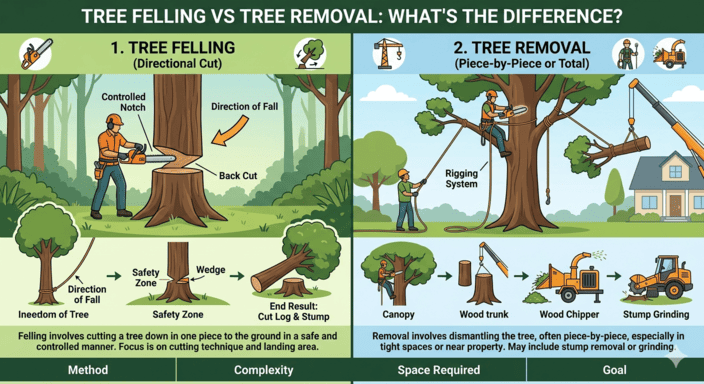
Tree felling and tree removal are two distinct processes that homeowners, land managers, and arborists use to eliminate trees from a property — but they are not interchangeable terms.
Tree felling refers to the act of cutting a standing tree at its base so it falls to the ground, while tree removal encompasses the complete elimination of a tree including its stump, root system, and all debris.
Understanding the difference between the two is especially important for property owners in Peoria, Illinois, where mature hardwoods, seasonal storms, and strict municipal tree ordinances make it essential to choose the right service, hire the right professional, and budget accurately for the job.
Defining Tree Felling: The Cut and Drop
Tree felling is the process of cutting through a tree’s trunk at or near ground level using a chainsaw, axe, or mechanical felling equipment — causing the tree to fall in a controlled direction. The operation ends the moment the tree hits the ground.
In Peoria, IL, tree felling on its own is most practical on larger rural or semi-rural lots — think properties along the outskirts of Peoria County or acreage in nearby Chillicothe and Dunlap — where there is sufficient open space for a tree to fall freely without endangering structures or neighboring yards.
What Tree Felling Involves
- Directional notch cutting — an arborist or feller cuts a wedge-shaped notch on the side facing the intended fall direction.
- Back cut — a horizontal cut is made on the opposite side of the notch, releasing the tree.
- Hinge wood — a strip of uncut wood between the notch and back cut guides the direction of the fall.
- Escape route planning — the feller designates a safe path to move away from the falling tree.
After felling, the trunk and branches remain on the ground. The stump stays in place. What happens next — limbing, bucking, hauling, or stump grinding — is an entirely separate scope of work.
When Tree Felling Alone Is Used
Tree felling without subsequent removal is common in:
- Timber harvesting — loggers fell trees and haul trunks to mills, leaving stumps behind.
- Land clearing for farming — large acreage, such as agricultural properties throughout Peoria County, where stumps will be dealt with separately.
- Firewood collection — the felled tree is bucked into rounds and left on-site for personal use through Illinois winters.
- Storm hazard reduction — after severe weather events like the derecho and ice storms that periodically impact Central Illinois, trees are dropped and cleared to restore safe access.
Defining Tree Removal: The Complete Process
Tree removal is a comprehensive service that encompasses felling (or dismantling) a tree and clearing everything that remains afterward.
It is the term most Peoria homeowners mean when they say they want a tree “taken away” — particularly in established residential neighborhoods like Kellar, Richwoods, and North Peoria, where homes sit close together and there is little room for error.
What Tree Removal Involves
Tree removal typically includes the following stages:
- Assessment and planning — an arborist evaluates the tree’s health, lean, proximity to structures, and the safest method of takedown.
- Felling or sectional dismantling — the tree is either felled in one piece (if space allows) or cut down in sections from the top down using rigging and ropes.
- Limbing and chipping — branches are removed and fed through a wood chipper.
- Bucking — the trunk is cut into manageable logs.
- Debris hauling — all material is loaded and removed from the property.
- Stump grinding or stump removal — the remaining stump is either ground to below ground level or excavated with the root ball entirely.
- Site cleanup — the area is raked, blown out, and left clear.
When Full Tree Removal Is Necessary in Peoria
- Diseased or dead trees — Peoria has seen significant tree loss from Emerald Ash Borer (EAB), which has devastated ash tree populations across Illinois. Dead ash trees in residential yards pose serious fall risks and typically require full removal.
- Trees too close to a home’s foundation, driveway, or utility lines — a common issue in Peoria’s older, tree-lined neighborhoods like Moss-Bradley and Sheridan Village.
- Pre-construction site clearing where roots must be fully eliminated.
- Trees uprooted by storms — Central Illinois thunderstorms and occasional tornadoes can uproot even large, healthy trees.
- Any situation where replanting or landscaping will follow.
Key Differences Between Tree Felling and Tree Removal
| Factor | Tree Felling | Tree Removal |
| Scope | Cutting only — tree falls to ground | Full process from cut to clean site |
| Stump | Left in place | Ground down or extracted |
| Debris | Left on site | Hauled away |
| Space required | Large clear fall zone needed | Can work in confined spaces via dismantling |
| Cost | Lower — less labor and equipment | Higher — multiple stages involved |
| Best for | Rural Peoria County land, open spaces | Peoria city lots, urban neighborhoods |
| Time on site | Hours (one operation) | Half day to full day or more |
| Permits needed | Check with City of Peoria | Check with City of Peoria |
Tree Felling Methods Explained
Not all trees can or should be felled the same way. Arborists in Peoria, Illinois select a method based on the tree’s size, condition, lean, and surroundings — particularly important given the region’s mix of towering cottonwoods, silver maples, oaks, and ash trees.
Straight Felling (Open-Area Felling)
The most straightforward method — used when there is ample open space in the desired fall direction with no structures, fences, or power lines at risk. The feller makes a notch and a back cut and the tree falls freely. This approach is well-suited to rural Peoria County properties and open farmland.
Mechanical Felling
On large-scale land clearing sites — such as new residential or commercial developments along the Route 6 corridor or expanding areas of Dunlap and Edwards — feller-buncher machines grip the trunk, make the cut, and lay the tree down without a human standing near it. This method dramatically increases speed and safety on open terrain.
Controlled Directional Felling
Used when obstacles are present but a clear fall path still exists. Wedges, pulling ropes, and precise notch geometry are used to steer the fall within a narrow corridor. This is frequently employed in Peoria’s suburban lots where a tree may lean toward a fence or detached garage.
Tree Removal Methods Explained
Sectional Dismantling (Piece by Piece)
The most common method used by Peoria tree removal companies working in residential areas.
A climber ascends the tree, removes branches and sections of trunk from the top down, and lowers each piece to the ground using ropes and rigging — preventing uncontrolled drops. This method is used when:
- The tree overhangs a roof, fence, or garden bed — extremely common on the narrow lots found throughout central and south Peoria.
- There is no safe fall zone on the property.
- The tree is dead or diseased (such as an EAB-killed ash tree) and structurally unpredictable.
Crane-Assisted Removal
A mobile crane lifts large sections of trunk directly off the tree and swings them to a clear drop zone. This is faster than sectional climbing, avoids damage to surrounding landscaping, and is preferred for very large trees in tight urban spaces — including large silver maples and cottonwoods common in Peoria Heights and along the Illinois River bluffs.
Whole-Tree Removal (Rural)
On rural properties throughout Peoria County with adequate space, the tree is felled in one piece and then processed on the ground — limbed, bucked, and chipped where it fell.
This is essentially tree felling followed immediately by on-site processing and is the most cost-effective approach for open acreage.
Stump Grinding vs Stump Removal: A Related Distinction
A tree cut at ground level leaves a stump, and how that stump is dealt with is another distinction worth understanding — especially for Peoria homeowners planning to replant, sod, or build on the cleared area.
- Stump grinding — a stump grinder chews the stump and surface roots down to 6–12 inches below grade. The hole is filled with the resulting wood chip mulch. The deep root system remains underground and decays naturally over several years. This is the most common and cost-effective option for residential properties in Peoria.
- Stump removal (full extraction) — the entire root ball is excavated using a backhoe or excavator. This creates a large hole but leaves the ground completely clear of organic material — the right choice if you are laying a new concrete driveway, building an addition, or installing underground utilities.
Neither is automatically included in a “tree felling” quote, but both are typically part of a full “tree removal” service — always confirm the scope with your Peoria contractor before signing.
Safety Considerations for Each Process
Felling Safety Risks
- Kickback and barber chairs — unexpected splits in the trunk during cutting can cause the chainsaw to kick or the trunk to split vertically and spring backward.
- Widow-makers — dead branches dislodged by the falling tree can fall on the feller. Particularly hazardous with Emerald Ash Borer-damaged trees in Peoria, which can shed limbs without warning.
- Inaccurate fall direction — lean, wind, or hidden internal decay can redirect the fall.
- Escape route obstruction — debris or uneven terrain can impede the feller’s retreat.
Removal Safety Risks
- Working at height — climbers face risks of falls, entanglement, and being struck by falling wood.
- Structural failure — dead ash trees and storm-damaged trees, both common in Central Illinois, may break unpredictably during climbing or rigging.
- Utility lines — Peoria’s older neighborhoods have numerous overhead power lines running through tree canopies; work near these lines requires coordination with Ameren Illinois.
- Equipment operation — chippers, cranes, and grinders each carry their own operational hazards.
Both processes require trained, insured professionals. DIY tree felling accounts for a significant number of serious injuries and fatalities each year — and in a densely settled city like Peoria, a mistake can damage neighboring property as well.
Cost Comparison: Tree Felling vs Tree Removal in Peoria, IL
Costs vary by tree size, species, location, and site access. The figures below reflect general market rates for the Peoria, Illinois area for a medium-sized residential tree (30–50 feet tall).
| Service | Estimated Cost Range (USD) |
| Tree felling only (no cleanup) | $250 – $700 |
| Tree felling + limbing and debris removal | $500 – $1,200 |
| Full tree removal (felling + stump grinding + cleanup) | $900 – $2,500+ |
| Stump grinding only (after felling) | $100 – $400 |
| Full stump extraction | $300 – $900 |
| Crane-assisted removal | $1,500 – $5,000+ |
Peoria tip: Large silver maples and cottonwoods — both prolific throughout the city — tend to sit at the higher end of these ranges due to their size, brittle wood, and the extra care required during removal.
Always obtain at least three written quotes from licensed Peoria tree service companies. Ensure each quote specifies exactly what is and is not included — particularly stump treatment and debris disposal.
Permits and Local Regulations in Peoria, Illinois
The City of Peoria regulates tree removal through its municipal code, and Peoria County has its own separate guidelines for unincorporated areas. Before scheduling any tree work, property owners should be aware of the following:
- City of Peoria parkway trees — trees growing in the public right-of-way (the strip between the sidewalk and the street) are the city’s property. You cannot remove or prune these trees without authorization from the City of Peoria Public Works Department.
- Private property trees — while Peoria does not require a permit for most private tree removals, certain protected species and trees in specific zoning overlays may have additional restrictions. Always verify before proceeding.
- Illinois Emerald Ash Borer regulations — there are state-level restrictions on moving ash wood and debris to prevent the spread of EAB to unaffected areas. Your arborist should be familiar with these rules.
- HOA restrictions — many Peoria-area HOAs, particularly in newer developments in Dunlap, Germantown Hills, and Morton (just outside Peoria), have their own tree removal approval processes.
Before booking any tree work in Peoria:
- Contact the City of Peoria Public Works Department to ask about right-of-way and parkway tree regulations.
- Confirm whether the tree is on private property or the public easement.
- Check with your HOA if applicable.
- Ask your arborist whether an Illinois-licensed contractor is required for your specific job.
Removing a city-owned parkway tree without authorization in Peoria can result in fines and a requirement to replace the tree at your own expense.
Conclusion
Tree felling and tree removal describe related but fundamentally different scopes of work.
Felling is a single act — the cutting of a tree at its base.
Removal is a complete service — felling or dismantling the tree, processing the debris, and eliminating the stump.
For Peoria, Illinois property owners, the distinction matters even more given the city’s aging tree canopy, the widespread impact of Emerald Ash Borer, dense residential neighborhoods, and specific municipal rules around parkway trees and public easements.
Knowing the difference allows you to ask the right questions, understand your quote, and ensure the job is done safely and completely.
When in doubt, consult an ISA Certified Arborist serving the Peoria area who can assess your specific situation and recommend the most appropriate, cost-effective, and legally compliant approach.