
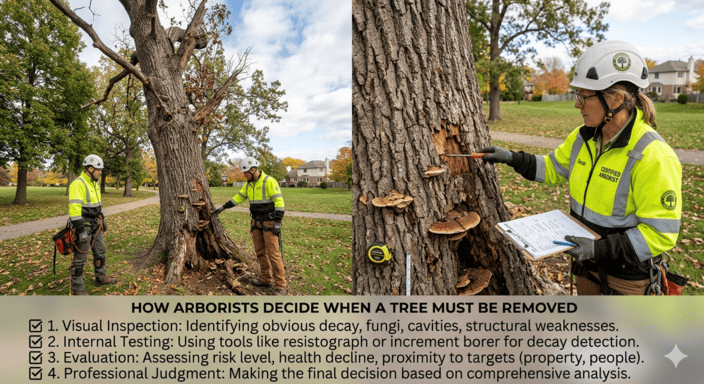
Arborists evaluate trees using structural, biological, and environmental criteria to determine removal necessity.
Dead, diseased, or hazardous trees require professional assessment before any action is taken. Certified tree care professionals follow a structured decision-making process rooted in both science and long field experience.
Structural Integrity Assessment
Reading the Trunk and Crown
The trunk is often the first place an arborist looks. Cracks, cavities, and cankers running along the main stem are warning signs that the tree’s core strength has been compromised.
A hollow trunk does not automatically mean removal — arborists use a combination of visual inspection and specialized tools like resistograph drills or sonic tomography to measure just how much solid wood remains.
The crown tells its own story. A thinning canopy, dieback at the tips of major branches, or epicormic shoots sprouting from the base all signal internal stress that may be beyond recovery.
Root Zone Problems
Root failure causes more sudden tree collapses than almost any other factor. Arborists examine the root flare at the base of the tree for signs of decay, fungal fruiting bodies, and soil heaving.
Compacted soil, grade changes, and nearby construction can sever or suffocate root systems well before visible symptoms appear in the canopy above.
Disease and Pest Damage
When Infection Crosses the Threshold
Not every infected tree is a candidate for removal. A skilled arborist distinguishes between a tree fighting off a localized infection and one experiencing systemic collapse.
Dutch elm disease, oak wilt, and thousand cankers disease are examples where spread can be so aggressive that removal becomes the only realistic option — both to end the tree’s suffering and to protect neighboring trees.
In Peoria, Illinois, the emerald ash borer has forced widespread ash tree removal decisions across the city. Arborists there, like their counterparts throughout the Midwest, must weigh treatment viability against canopy loss when managing infestations at scale.
Fungal Decay Indicators
The presence of conks, shelf fungi, or mushrooms at the root flare or along the trunk is a serious indicator of advanced internal wood decay. Species such as Ganoderma and Armillaria suggest that the structural wood is being consumed from within. At a certain point of decay progression, no treatment can restore the tree’s mechanical integrity.
Risk Assessment and Target Identification
The Two-Part Equation
Arborists think about risk in terms of likelihood and consequence. A tree with moderate decay growing in a remote woodland poses very little risk.
That same tree growing over a roof, a playground, or a utility line is an entirely different calculation. The presence and proximity of what professionals call “targets” — people, property, or infrastructure — elevates the urgency of any structural concern.
Failure Zone Analysis
Part of a formal tree risk assessment involves mapping the potential failure zone: the arc of ground that would be struck if the tree or a major limb were to fall. This analysis directly influences whether removal is urgent, scheduled, or simply monitored over time.
Species, Age, and Adaptability
Mature Trees and Decline
Every tree species has a natural lifespan, and older specimens can reach a stage of senescence where decline outpaces the tree’s ability to compartmentalize wounds and resist pathogens.
This doesn’t mean old trees are automatically removed — ancient trees often carry significant ecological and historical value — but age amplifies the weight given to structural concerns.
Poor Site Match
A tree planted in the wrong location decades ago may eventually become a removal candidate simply because it has outgrown its site.
Root systems lifting sidewalks, branches interfering with power lines, and canopy overwhelming nearby structures are common site compatibility issues that arborists address regularly in urban and suburban environments.
The Role of Mitigation Options
Pruning, Cabling, and Bracing
Removal is never the first option a responsible arborist reaches for. Structural pruning can reduce end-weight on compromised limbs.
Cabling and bracing systems provide supplemental support for trees with co-dominant stems or included bark. These interventions can extend a tree’s safe life considerably when implemented correctly.
When Mitigation Is No Longer Viable
There comes a point where further mitigation would require more intervention than the tree can structurally tolerate, or where the cost of ongoing management outweighs any reasonable benefit.
At that threshold, an arborist will document their findings, explain the reasoning to the property owner, and recommend removal as the responsible course of action.
Professional Standards and Documentation
Certified arborists follow guidelines established by the International Society of Arboriculture, including the Tree Risk Assessment Qualification framework. This standardized approach ensures that removal decisions are defensible, consistent, and grounded in observable evidence rather than guesswork.
Proper documentation — photographs, written reports, and risk ratings — protects both the homeowner and the arborist, and ensures that the reasoning behind a removal recommendation is clear and transparent.
Final Thoughts
Tree removal is one of the most consequential decisions in arboriculture. It is never taken lightly by professionals who understand that a mature tree represents decades of growth, ecosystem value, and community character.
The decision emerges from a careful reading of structure, health, risk, and context — and in the hands of a qualified arborist, it is always the conclusion of a process, never the starting point.