
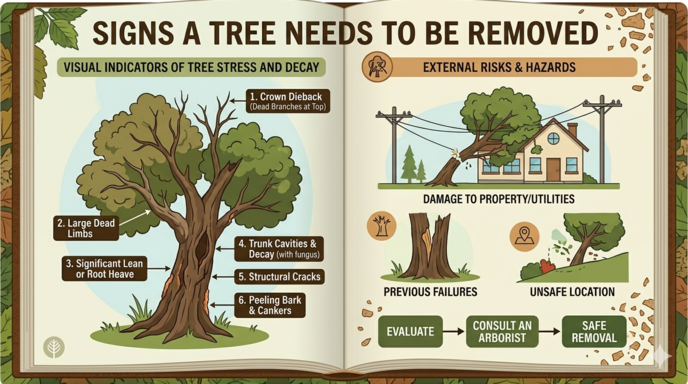
A tree needs to be removed when structural failure, advanced disease, severe root damage, or irreversible decline creates an unacceptable safety risk to people, structures, or surrounding property.
Homeowners, certified arborists, and property managers identify these warning signs through visual inspection, professional hazard assessment, and ongoing tree health monitoring.
Catching these signs early — before a tree fails — is the difference between a planned, cost-controlled removal and an emergency response after a tree has fallen on a home, vehicle, or power line.
In central Illinois communities like Peoria, where mature oaks, elms, and ash trees are common across residential neighborhoods, recognizing these warning signs is especially important given the region’s exposure to severe thunderstorms, ice storms, and high-wind events.
Structural Defects: The Most Urgent Warning Signs
Structural defects are the leading reason certified arborists recommend removal. Unlike disease, which may progress slowly, structural failure can happen without warning — during a storm, high winds, or even on a calm day.
Trunk Cracks and Cavities
Deep vertical cracks running through the trunk — called shakes or splits — indicate that the tree has lost internal structural integrity. A crack that passes through the full diameter of the trunk is a critical failure point.
Cavities, where the interior wood has rotted away, hollow out the tree’s load-bearing core. A tree with a cavity occupying more than one-third of its trunk diameter is generally considered a removal candidate.
Severe Lean
A gradual, lifelong lean is normal for many trees — it is not inherently dangerous. A sudden lean, however, is an emergency. When a tree develops a new or rapidly increasing lean, it typically signals root failure or soil heaving on the opposite side. Sudden lean combined with cracked or raised soil at the base is one of the clearest indicators that a tree is actively failing and must be removed immediately.
Co-Dominant Stems and Included Bark
Trees with two or more main stems (co-dominant stems) of roughly equal size are prone to splitting at the union. When bark becomes trapped between the stems — a condition called included bark — the union lacks the interlocking wood grain that provides strength.
These attachments are inherently weak and frequently fail under load, especially during storms or ice events.
In Peoria, where ice storms are a regular winter occurrence, co-dominant stems are one of the most common structural failure points arborists encounter following severe weather.
Advanced Disease and Fungal Infection
Disease alone does not always necessitate removal — many trees survive and recover from fungal infections with proper treatment. However, certain disease presentations signal that the tree is beyond saving.
Fungal Conks and Bracket Fungi
The presence of mushrooms, conks, or shelf fungi growing directly from the trunk or major roots is a reliable indicator of advanced internal decay.
These fruiting bodies are the visible expression of fungi that have been consuming the tree’s structural wood for months or years.
By the time conks appear, the internal damage is typically extensive. Common decay fungi to watch for include Ganoderma (artist’s conk), Laetiporus (chicken of the woods), and Armillaria (honey fungus), all of which cause serious structural compromise.
Canopy Dieback
Progressive dieback starting at the tips of branches and moving inward — called tip dieback or crown dieback — indicates systemic decline.
When more than 50% of the canopy shows dieback, the tree lacks the photosynthetic capacity to sustain itself, recover from stress, or resist secondary pest attack. At this threshold, most arborists recommend removal.
Oak Wilt and Dutch Elm Disease
Certain vascular diseases — including oak wilt and Dutch elm disease — spread through root grafts to neighboring trees.
A tree infected with a communicable vascular disease may need to be removed not just because it is dying, but to prevent transmission to healthy trees on the same property or adjacent properties.
Prompt removal and proper debris disposal are critical containment measures.
Root Damage and Soil Instability
The root system is the tree’s foundation. Root damage is particularly dangerous because it is largely invisible until failure is imminent.
Construction and Soil Compaction Damage
Root systems are highly sensitive to grade changes, soil compaction, and trenching within the critical root zone (CRZ) — typically defined as a radius of 1 foot per inch of trunk diameter.
Construction activity within the CRZ — including the installation of driveways, foundations, irrigation systems, and utility lines — can sever or suffocate enough roots to destabilize a large tree years after the work was completed.
Root Intrusion into Structures
Tree roots that have grown into foundation walls, sewer lines, or underground drainage systems indicate a tree whose root system is incompatible with its location.
Beyond the infrastructure damage, these trees are frequently destabilized by the eventual repair work — making removal both a structural and safety necessity.
Raised or Cracked Soil at the Base
Soil lifting, heaving, or cracking in a curved pattern around the base of a tree is a visible sign of root plate failure. This occurs when the lateral roots anchoring the tree to the ground have decayed, broken, or been severed. A tree with root plate failure is at imminent risk of uprooting and should be treated as an emergency removal.
Pest Infestation
Certain pest infestations are so destructive that they render trees unsavable — particularly when the damage has progressed beyond the point where treatment is effective.
Emerald Ash Borer
The emerald ash borer (EAB) is a wood-boring beetle that has devastated ash tree populations across North America.
Central Illinois — including the Peoria area — has been significantly affected, with ash trees in both urban and suburban settings lost to EAB over the past two decades. Infestation signs include S-shaped galleries under the bark, D-shaped exit holes, vertical bark splits, and canopy dieback.
Untreated EAB infestation is fatal to ash trees within 2–4 years of initial attack. Trees with more than 50% canopy loss due to EAB are generally beyond treatment and should be removed before they become hazards.
Bark Beetle Infestations
Bark beetles attack stressed or weakened trees, boring through the outer bark to lay eggs in the cambium layer.
Heavy infestations — indicated by pitch tubes, frass, and widespread woodpecker activity — can girdle a tree rapidly. Infested trees that cannot be saved through targeted treatment are removal candidates, particularly when they are adjacent to healthy trees that could be colonized.
Dead Trees: Always a Removal Priority
A dead tree — regardless of how structurally sound it appears — is a removal priority. Dead wood loses moisture and becomes progressively more brittle over time.
The timeline from death to dangerous brittleness varies by species and climate, but most dead trees become hazardous within 1–3 years. The risks include:
- Sudden limb drop, which can occur with no wind or warning
- Complete uprooting during storms, as dead roots lose tensile strength
- Accelerated decay at the base, creating a hidden failure point
- Increased fire risk in dry climates
Dead trees near occupied structures, high-traffic areas, or vehicles should be removed as soon as possible after the tree is confirmed dead.
Hazard Assessment: Proximity to Structures and People
Even a moderately compromised tree may be acceptable in a remote woodland setting — but the same tree directly adjacent to a home, driveway, playground, or power line becomes a high-priority removal.
Arborists use a formal hazard assessment framework to evaluate risk based on two factors: the likelihood of failure and the consequence of failure.
A tree with a moderate failure probability but located directly above a child’s bedroom carries a far higher risk rating than a tree with the same defects in an open field.
ISA’s Tree Risk Assessment Qualification (TRAQ) framework formalizes this calculation, helping arborists assign a risk rating of low, moderate, high, or extreme — with extreme-risk trees requiring immediate action.
Utility Clearance
Trees that have grown into or are threatening overhead power lines require either utility clearance pruning by the utility company or full removal.
Trees in direct contact with power lines create electrocution risks for anyone touching the tree, fire risks from arcing, and outage risks for the surrounding neighborhood.
If a tree cannot be pruned to a safe clearance distance without removing the majority of its canopy, removal is typically the preferred outcome.
Storm Damage Assessment
Severe storms frequently expose pre-existing structural weaknesses. In the Peoria region, late spring and summer thunderstorms — including periodic derecho and straight-line wind events — regularly produce the kind of sudden, high-load conditions that trigger failure in already-compromised trees.
A tree that has partially failed — with major scaffold branches broken, bark stripped from the trunk, or the root plate partially lifted — requires an immediate post-storm hazard assessment. Not all storm-damaged trees need to be removed, but the following conditions typically warrant it:
- More than 50% of the crown has been lost or destroyed
- The main leader (central trunk) has been broken or split
- The root plate has lifted more than a few inches
- Multiple co-dominant stems have split at the union
- The tree has struck a structure and is partially suspended
A tree that has already partially failed once is statistically more likely to fail again — and under lighter load conditions than the original storm.
When a Certified Arborist Recommends Removal
The most reliable signal that a tree needs to be removed is a formal recommendation from an ISA Certified Arborist following an on-site assessment.
Arborists are trained to evaluate the full picture — not just the visible symptoms, but the species’ typical failure patterns, the site conditions, the tree’s history, and the risk tolerance appropriate for the location.
Homeowners are sometimes reluctant to remove trees they have an emotional attachment to, or that provide significant shade value.
A good arborist will always attempt to find a preservation path first — through targeted pruning, cabling and bracing, or disease treatment.
A recommendation for removal from a qualified arborist should be taken seriously: it means the tree’s preservation options have been exhausted.
Permits and Regulations Before Removal
Before removing any significant tree, check local regulations. In Peoria, Illinois, tree removal on private property may be subject to city ordinance requirements depending on tree size, species, and location — particularly for trees near public rights-of-way or within designated conservation areas.
Most municipalities require a tree removal permit for trees above a certain trunk diameter — commonly 6–12 inches DBH (diameter at breast height). Protected species, heritage trees, and trees within designated preservation zones may require additional review or replacement planting as a condition of removal.
Removing a tree without the required permit can result in substantial fines, mandatory replanting orders, and complications with property transactions.
Your tree service provider should be familiar with local permit requirements — a reputable company will pull permits on your behalf as part of the service.
The Cost of Waiting
Delaying the removal of a tree that shows clear failure indicators rarely saves money — it almost always increases cost and risk.
The longer a hazardous tree stands, the more likely it is to fail during a storm or high-wind event, resulting in property damage, personal injury liability, and emergency removal costs that typically run 2–3 times the price of a planned removal.
Regular tree health assessments — ideally every 3–5 years by a certified arborist — are the most effective way to catch these warning signs early, make informed decisions, and avoid the far greater costs of reactive emergency response.
For Peoria homeowners, scheduling an assessment in early spring — before storm season — is a practical habit that can prevent a manageable situation from becoming a costly emergency.