
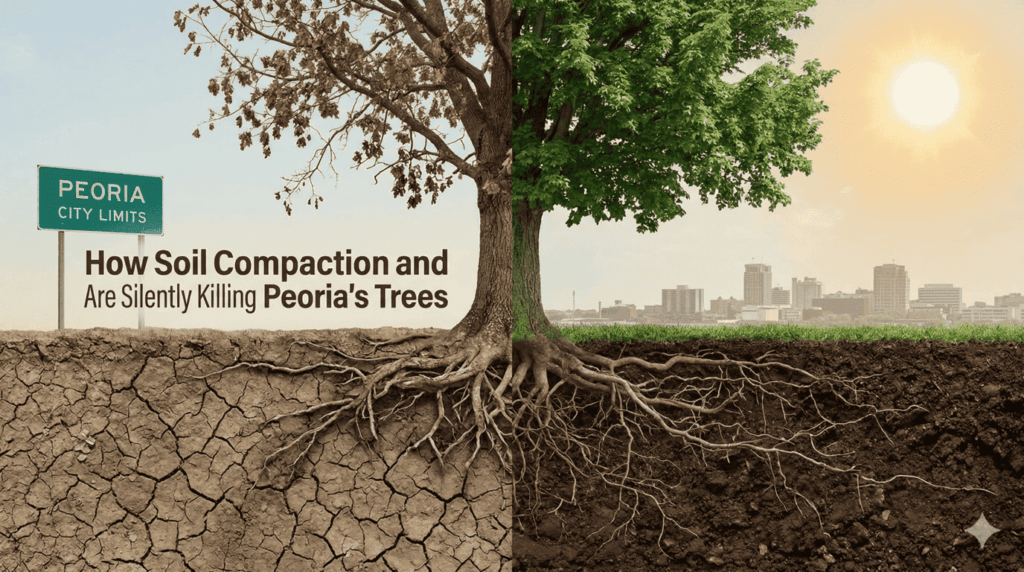
Soil compaction and drought damage trees by restricting root oxygen, blocking water uptake, and breaking down the structural integrity of the root zone — often years before visible symptoms appear above ground. In Peoria, IL, a combination of heavy clay soils, periodic summer drought, construction activity, and urban heat pressure makes local trees especially vulnerable to both stressors. Many homeowners notice wilting, early leaf drop, or branch dieback and assume disease or pests are to blame — when the real cause lies inches beneath the surface.
What Is Soil Compaction and Why Does It Matter?
Soil compaction occurs when soil particles are pressed together, eliminating the pore spaces that hold oxygen, water, and beneficial microorganisms. Healthy soil is roughly 50% solid particles and 50% pore space. Compacted soil may have pore space reduced to less than 10%, creating conditions that are effectively hostile to root growth.
In Peoria, compaction commonly results from:
- Vehicle and foot traffic on lawn areas
- Construction and grading near existing trees
- Heavy equipment operation during landscaping projects
- Repeated mowing on wet soil
- Natural settling in clay-heavy soils after rain
Peoria sits within a region dominated by Drummer and Flanagan silt loam soils — both prone to surface sealing and compaction under pressure. Once compacted, these soils resist rehydration and become nearly impenetrable to new root growth.
How Drought Stresses Trees in the Peoria Region
Peoria averages around 36 inches of annual precipitation, but distribution is uneven. Dry spells concentrated in July and August — the period of peak tree water demand — regularly push trees into moisture deficit. Even trees that appear healthy entering summer can experience significant internal stress within a few weeks of limited rainfall.
Drought impacts trees through several mechanisms:
- Reduced turgor pressure causes stomatal closure and slows photosynthesis
- Xylem vessels can cavitate (form air bubbles), permanently disrupting water transport
- Fine feeder roots — responsible for most water absorption — die back first
- Weakened trees become susceptible to secondary invaders like borers, cankers, and fungal pathogens
Urban trees in Peoria face compounded drought risk. Pavement and buildings increase radiant heat, raising soil temperatures and accelerating moisture loss. Restricted root zones limit the volume of soil trees can draw on during dry periods.
The Compounding Effect: When Compaction and Drought Occur Together
Soil compaction and drought do not simply add their effects — they amplify each other. Compacted soil reduces infiltration rates, meaning rainfall that does occur runs off rather than reaching roots. At the same time, compacted soil holds less plant-available water, so what moisture does exist is quickly exhausted.
For Peoria trees, this creates a dangerous cycle:
- Heavy spring rains compact the soil surface and run off without penetrating
- Summer drought arrives with no soil moisture reserve
- Roots, already confined by compaction, cannot expand to find water
- The tree enters severe stress, triggering branch dieback or full decline
Research from university extension programs consistently shows that trees experiencing both compaction and drought stress have significantly higher mortality rates than trees facing either stressor alone.
Warning Signs to Watch for in Peoria Trees
Because both stressors work underground first, many Peoria homeowners miss early warning signs. By the time symptoms appear in the canopy, root damage is often already severe.
Early Indicators
- Smaller-than-normal leaf size in spring
- Pale or yellowing foliage mid-season
- Early fall color or premature leaf drop
- Sparse canopy with fewer leaves than prior years
Advanced Indicators
- Dieback progressing from branch tips inward (tip dieback)
- Bark cracking or sunscald on the trunk
- Crown thinning visible from a distance
- Presence of borer exit holes or fungal conks — secondary invaders that exploit weakened trees
If you observe any of these symptoms in Peoria trees — particularly following a dry summer or after construction activity — compaction and drought stress should be among the first conditions investigated.
Trees Most Vulnerable in Peoria’s Landscape
Not all trees respond equally to compaction and drought. Species with shallow, fibrous root systems and those sensitive to anaerobic (low-oxygen) soil conditions tend to decline most rapidly.
Particularly vulnerable species commonly found in Peoria include:
- Sugar maple (Acer saccharum) — sensitive to both compaction and drought; common in older Peoria neighborhoods
- White oak (Quercus alba) — deep-rooted but slow to recover from root zone disturbance
- Flowering dogwood (Cornus florida) — shallow-rooted and prone to rapid drought stress
- American beech (Fagus grandifolia) — highly sensitive to soil disturbance
- River birch (Betula nigra) — requires consistent moisture; struggles in compacted urban settings
More tolerant species — such as Kentucky coffeetree, bur oak, and honeylocust — are often better choices for high-traffic areas or sites where compaction cannot be fully remediated.
How to Test Your Soil for Compaction
Peoria homeowners can perform basic compaction assessments without professional equipment. A simple penetrometer (soil probe) pushed into the ground provides a rough measurement of resistance. Soil that resists penetration beyond 2–3 inches with moderate hand pressure is likely compacted beyond healthy thresholds for root growth.
Other field tests include:
- Screwdriver test: Push a standard screwdriver 6 inches into moist soil with hand pressure alone — difficulty indicates compaction
- Water infiltration test: Pour a gallon of water into a 12-inch-wide ring pressed into the soil; compacted soil will pool rather than absorb within 30 minutes
- Earthworm count: Dig a 1-cubic-foot hole and count earthworms — fewer than 10 per cubic foot suggests poor soil biology often associated with compaction
The University of Illinois Extension — which serves the Peoria region — also offers soil testing services that include compaction assessment and soil health recommendations specific to central Illinois soil types.
Treatment and Recovery: What Actually Works
Recovering compacted soil and drought-stressed trees requires a multi-pronged approach. There is no single fix, and recovery timelines depend on the severity of damage and the species involved.
Vertical Mulching and Air Spading
Vertical mulching involves drilling or cutting holes in the soil within the root zone and filling them with compost, perlite, or coarse sand to create pathways for root growth and air exchange. Air spading uses compressed air to fracture compacted soil without damaging existing roots — a technique now standard among certified arborists in the Peoria area.
Deep Root Watering
Surface watering on compacted soil rarely reaches tree roots. Deep root watering — using stakes or probes to deliver water 12–18 inches below the surface — bypasses runoff and directly targets the active root zone. During Peoria drought periods, deep root watering every 7–10 days can prevent critical moisture deficit.
Mulching the Critical Root Zone
Applying 3–4 inches of organic mulch over the root zone — extending to the dripline where possible — reduces soil temperature, retains moisture, prevents surface compaction from foot traffic and rain impact, and gradually improves soil structure as it decomposes. Avoid volcano mulching (piling mulch against the trunk), which promotes rot.
Soil Biology Restoration
Compacted, drought-stressed soils often have depleted microbial communities. Applications of compost tea, mycorrhizal inoculants, and quality compost amendments help restore the soil food web — improving both water retention and nutrient cycling over time.
Prevention: Protecting Peoria Trees Before Damage Occurs
Prevention is far more effective — and far less expensive — than treatment. Homeowners and property managers in Peoria can take proactive steps to keep trees healthy before compaction and drought take hold.
- Establish and enforce tree protection zones before any construction or grading work begins — the minimum radius is 1 foot per inch of trunk diameter
- Avoid driving, parking, or repeatedly walking over the root zone of established trees
- Install mulched beds under tree canopies to discourage foot traffic and reduce compaction from rain impact
- Water established trees during extended dry periods, targeting the outer half of the root zone rather than the base of the trunk
- Avoid turf fertilizers high in nitrogen near tree roots — they can alter soil biology and dry out the root zone
- Consider permeable paving options near trees when hardscaping projects are planned
When to Call a Certified Arborist in Peoria
Some situations warrant professional assessment rather than DIY intervention. Contact an ISA-certified arborist serving the Peoria area if you observe:
- Significant canopy dieback covering more than 25% of the crown
- Trunk wounds, cracks, or fungal growth at the base
- A tree near a recent construction project showing any decline symptoms
- Multiple trees in the same area declining simultaneously — a pattern often indicating a soil-wide compaction problem
- Any high-value or heritage tree showing stress symptoms
The ISA (International Society of Arboriculture) maintains a searchable database of certified arborists by ZIP code. For Peoria, certified arborists can perform soil assessments, prescribe targeted treatments, and recommend species-appropriate recovery plans.
The Invisible Threat Beneath Peoria’s Trees
Soil compaction and drought are not dramatic, sudden killers — they are slow, cumulative, and easy to misdiagnose. In Peoria’s urban and suburban landscape, where clay soils, development pressure, and dry summers converge, these two stressors represent the leading cause of preventable tree loss.
The good news is that with early detection, appropriate treatment, and proactive soil management, most trees can recover — or be protected before stress reaches critical levels. Investing in the soil beneath your trees is, ultimately, the most effective tree care decision a Peoria property owner can make.