
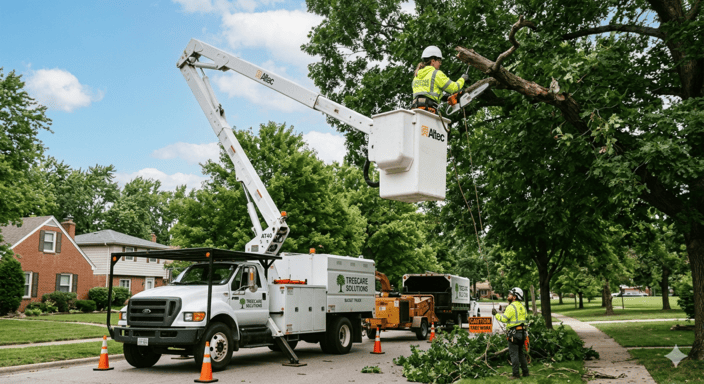
A bucket truck is a specialized vehicle equipped with an aerial work platform (the “bucket”) that lifts workers safely to elevated heights — and arborists use it to perform tree trimming, pruning, removal, and emergency storm response work that would otherwise be impossible or dangerous to accomplish from the ground or with climbing gear alone.
What Is a Bucket Truck?
A bucket truck — also called a cherry picker, aerial lift truck, or boom truck — is a commercial vehicle fitted with a hydraulic or pneumatic articulating boom arm. At the end of that arm sits an enclosed aerial work platform (the “bucket” or “basket”) large enough to hold one or two workers and their tools.
The vehicle’s chassis is typically a standard heavy-duty truck (Ford F-550, International WorkStar, etc.), while the boom mechanism is mounted to the truck bed. Most bucket trucks used in arboriculture offer working heights between 35 and 65 feet, though specialized units can reach over 100 feet.
Key Components
- Boom arm — Articulates in multiple sections (lower boom, upper boom, jib) to navigate around branches and obstacles
- Work platform / bucket — Steel or fiberglass basket with safety harness anchor points and tool holders
- Hydraulic system — Powers all boom movements; most modern units include emergency hand-pump backup
- Outriggers / stabilizers — Extend from the truck frame to prevent tipping during operation
- Controls — Dual-station controls at both the platform and the truck base for safety redundancy
Types of Bucket Trucks Used in Tree Work
Not all bucket trucks are created equal. Arborists choose between several configurations depending on job type and terrain:
1. Articulating Boom Trucks
The most common type in tree care. The multi-jointed arm allows workers to reach over obstacles — like a roof or fence — rather than going straight up. Ideal for residential work.
2. Telescoping Boom Trucks
Extend in a straight line, offering greater maximum height. Best for open utility corridors or large commercial properties.
3. Over-Center / Non-Over-Center Models
Over-center units allow the boom to swing past vertical (180°+), significantly expanding reach. Non-over-center models are simpler and less expensive but have tighter working envelopes.
4. Insulated (Dielectric) Boom Trucks
Feature fiberglass boom sections and insulated buckets rated for proximity to energized power lines. Essential for utility line clearance work.
Why Arborists Use Bucket Trucks
Tree care professionals don’t reach for a bucket truck because it’s convenient — they use it because certain jobs genuinely demand it. Here’s why:
Safety Above All Else
Climbing large, structurally compromised, or dead trees is dangerous. A bucket truck keeps the arborist in a secured, stable platform rather than suspended by ropes inside a potentially unstable canopy. For dead-standing trees (snags) or storm-damaged specimens, aerial lifts are often the only ANSI Z133-compliant option.
Speed and Efficiency
An experienced climber may take 30–45 minutes to rig into a large oak before any cuts are made. A bucket truck operator can be at working height in under five minutes. On multi-tree jobs, this efficiency difference is dramatic and directly impacts labor costs.
Precision Placement of Cuts
Bucket trucks allow arborists to position themselves exactly where a cut needs to happen, with both hands free to operate a chainsaw or pole saw without managing climbing lines simultaneously. This precision reduces the risk of bark tearing, improper cut angles, and branch drop accidents.
Handling Large and Hazardous Trees
When a tree is leaning over a structure, neighboring a utility line, or showing signs of decay, climbing it multiplies the hazard. A bucket truck keeps the worker separated from the most dangerous zones while still allowing full-canopy access.
Emergency Storm Response
Following wind events, ice storms, or hurricanes, arborists are called to remove hanging limbs (“widow makers”), uprighted root balls, and leaning trees threatening structures. Speed and safety converge in these scenarios — bucket trucks allow crews to operate quickly without exposing climbers to unpredictable, compromised wood.
Bucket Truck vs. Tree Climbing: When to Use Each
| Scenario | Bucket Truck | Climbing |
|---|---|---|
| Large canopy removal | ✅ Preferred | ✅ Viable |
| Tight residential yards | ⚠️ Limited access | ✅ Preferred |
| Dead or hazardous trees | ✅ Preferred | ❌ Not recommended |
| Utility line clearance | ✅ Required (insulated) | ❌ Restricted |
| Storm damage response | ✅ Preferred | ⚠️ Situational |
| Steep terrain / slopes | ❌ Limited | ✅ Preferred |
| Pruning for aesthetics | ⚠️ Overkill on small trees | ✅ Preferred |
Limitations of Bucket Trucks in Arboriculture
Bucket trucks are powerful tools, but they aren’t the right solution for every job:
- Ground access — The truck needs stable, reasonably level ground with enough clearance (typically 10–12 feet wide). Soft or wet soil can cause sinking and destabilize outriggers.
- Overhead obstacles — Power lines, overhangs, and other trees can limit boom positioning.
- Cost — Bucket truck-equipped crews charge more than climbing-only crews; the equipment itself ranges from $80,000 to $300,000+ new.
- Small tree work — For routine pruning of small ornamentals, a bucket truck is excessive. A pole pruner or ladder is more practical.
Safety Standards and Operator Requirements
Operating a bucket truck in tree care is governed by several standards:
- ANSI Z133 — The American National Standard for arboricultural operations, which sets safety requirements for aerial lift use in tree care
- OSHA 29 CFR 1910.67 — Federal regulations on vehicle-mounted elevating and rotating work platforms
- CDL Requirements — Many bucket trucks exceed 26,000 lbs. GVWR and require a Commercial Driver’s License (CDL) to operate on public roads
- Manufacturer training — Most reputable tree care companies require operators to complete manufacturer-specific training and annual recertification
Arborists should always conduct a pre-operation inspection, establish a drop zone, wear fall protection harnesses while in the bucket, and never exceed the platform’s rated load capacity.
What to Look for When Hiring an Arborist with a Bucket Truck
If you’re hiring a tree service that will deploy a bucket truck on your property, ask:
- Is the crew ISA-certified? The International Society of Arboriculture credential indicates trained, professional tree care knowledge.
- Are they insured? Bucket truck work carries significant liability exposure. Verify general liability and workers’ compensation coverage.
- Do they follow ANSI Z133? This standard is the industry benchmark for safe aerial operations.
- Will they protect your lawn and hardscape? Ground protection mats should be used to prevent soil compaction and damage from stabilizing outriggers.
Conclusion
A bucket truck is far more than a tall ladder on wheels — it is a precision aerial tool that allows arborists to work safely, efficiently, and effectively at heights that would otherwise demand prohibitive risk. From routine canopy management to emergency hazard removals, the bucket truck has become a cornerstone of professional tree care. When you see one parked outside a neighbor’s house with an arborist suspended in the canopy, you’re watching a careful marriage of machinery, training, and tree science at work.
Related Topics: Equipment Used in Professional Tree Removal