
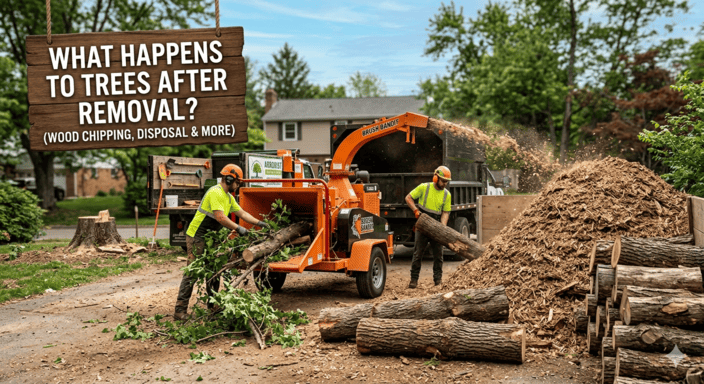
So you’ve just had a tree removed — or you’re planning to — and you’re wondering: where does it all go? You’re not alone.
Most homeowners assume the crew hauls everything away and that’s the end of it. But the reality is far more interesting (and often greener) than you’d think.
From industrial wood chippers to mulch giveaways, lumber mills to composting programs, removed trees follow a surprisingly purposeful journey.
This guide breaks down exactly what happens after a tree comes down, so you know what to expect — and how to make the most of it.
The Tree Removal Process: What Gets Left Behind
Before diving into disposal, it helps to understand what a tree removal job actually produces. When a professional arborist or tree service removes a tree, the work is broken into phases:
- Limbing — removing branches from the trunk
- Sectioning — cutting the trunk into manageable logs
- Stump cutting — felling the tree at or near the base
- Cleanup — gathering debris, branches, and wood chips
Each phase generates a different category of material: leafy brush, small branches, large logs, and the stump itself. Each of these is handled differently, which is why “tree disposal” isn’t one single process — it’s several.
Wood Chipping: The Most Common Outcome for Branches
The most visible part of any tree removal is usually the chipper truck idling at the curb. Wood chippers are industrial machines that shred branches, limbs, and brush into small wood chip fragments, typically ½ to 2 inches in size.
How Wood Chippers Work
A drum or disc chipper pulls branches through a feed chute and slices them with rotating blades at high speed. The resulting chips are blown into a truck bed or collection bag. Larger chippers can handle limbs up to 18 inches in diameter.
What Happens to the Wood Chips?
The chips don’t just disappear into the truck. They typically end up in one of these places:
- Mulch resale — Many tree companies sell chips to landscaping suppliers or municipal programs
- Free mulch programs — Cities and tree services sometimes offer free wood chips to homeowners. Websites like ChipDrop connect arborists with gardeners who want free mulch delivered
- Biomass energy — Large-scale operations may send chips to biomass power plants where they’re burned to generate electricity
- Composting facilities — Chips are a “brown” carbon material that balances nitrogen-rich food scraps in industrial compost operations
- Playground or trail surfacing — Municipalities use wood chips as a low-cost, natural ground cover
Should You Keep Your Own Wood Chips?
Yes — and many homeowners don’t realize they can request this. If your tree service is chipping on-site, ask them to leave the chips in your yard. Wood chip mulch is excellent for:
- Suppressing weeds around garden beds
- Retaining soil moisture
- Insulating plant roots in winter
- Slowly improving soil structure as it breaks down
A 3–4 inch layer of wood chip mulch around trees and shrubs is one of the best things you can do for your landscape.
What Happens to the Logs and Large Wood
Smaller branches go into the chipper, but what about the main trunk and large limb sections? These are handled differently based on their size, species, and the tree company’s relationships with downstream buyers.
Firewood
The most common fate for trunk sections is firewood. Tree companies either:
- Sell split firewood as a supplemental revenue stream
- Offer logs to homeowners who have a wood stove or fireplace (always ask — many companies will leave logs for free rather than haul them)
- Donate to community programs that provide firewood to families in need
Hardwoods like oak, hickory, maple, and cherry are prized for firewood because they burn hot and long. Softwoods like pine burn faster and are better suited for kindling.
Lumber Mills and Salvage Operations
High-value species — walnut, live oak, old-growth pine, cherry, and pecan — are sometimes too valuable to chip or burn. In these cases:
- Urban lumber mills will purchase or accept logs for milling into dimensional lumber or slabs
- Woodworkers and furniture makers often seek out urban trees for their unique grain patterns and character
- Architectural salvage firms may process large sections into beams, mantels, or decorative elements
Urban wood salvage is a growing movement aimed at keeping usable timber out of landfills. Organizations like theUrban Wood Network help connect tree services with mills and craftspeople.
What If the Wood Is Diseased or Pest-Infested?
Diseased trees require special handling. Wood from trees infected with pests like the emerald ash borer or spotted lanternfly is often subject to quarantine regulations. Moving infested wood can spread pests to new areas, so local regulations may require:
- On-site chipping (chips are less likely to harbor pests)
- Burning at the source
- Heat treatment before transport
- Disposal at designated facilities
Always check with your local extension service or department of agriculture if your removed tree was diseased.
Stump Removal and What Happens Underground
The stump is the most stubborn part of any removal. There are two main approaches, and they produce very different outcomes.
Stump Grinding
The most common method, stump grinding uses a rotating carbide-tipped wheel to grind the stump 6–12 inches below ground level. This leaves behind:
- A mound of wood grindings — a mix of sawdust, wood chips, and soil. This material can be used as mulch (though it’s high in carbon and will temporarily tie up nitrogen in the soil), or hauled away
- The root system — stump grinding does not remove the roots. The root system remains underground and will slowly decompose over 5–10 years
The leftover hole is typically backfilled with the grindings and/or fresh topsoil.
Full Stump and Root Removal
Less common and more expensive, full extraction involves digging out the root ball entirely. This is usually done when:
- The area will be used for construction or a new foundation
- A new tree will be planted in the same location
- The root system is causing damage to utilities or hardscape
The excavated material — roots, soil, and organic matter — is usually hauled to a composting or green waste facility.
Municipal Green Waste and Composting Programs
Many cities have green waste programs specifically designed to handle yard debris including tree removal material. Depending on your municipality:
- Curbside yard waste pickup accepts branches up to a certain diameter (often 4–6 inches), tied in bundles
- Drop-off composting sites accept larger volumes of material including logs and stumps in some cases
- Seasonal brush pickup programs collect large loads of woody debris after storms or in designated weeks
This material is processed at composting facilities where it’s ground, moistened, and turned into finished compost that’s often sold back to residents or used in public landscaping.
Eco-Friendly and Creative Reuses for Removed Trees
Beyond the conventional routes, removed trees find second lives in some creative ways:
Habitat Logs (“Snag” Creation)
Large trunk sections can be placed in natural areas or backyards as habitat logs. They provide shelter and food sources for:
- Woodpeckers and cavity-nesting birds
- Native bees and beneficial insects
- Salamanders, frogs, and small mammals
A single large log left to decompose can support hundreds of species over its lifetime.
Garden Art and Landscaping Features
Cut trunk sections make excellent:
- Natural stepping stones in garden paths
- Raised bed borders for vegetable gardens
- Rustic seating for outdoor spaces
- Planter bases for container gardens
Wood Turning and Craft Use
Hobbyist woodworkers prize “green” (freshly cut) urban wood for turning bowls, carving, and craft projects. If you have an interesting tree species, post in local woodworking forums — someone may collect it for free.
How to Minimize Waste When Having a Tree Removed
If sustainability is important to you, here’s how to be proactive before and during tree removal:
- Ask your arborist in advance what they do with removed material — a reputable company should have a clear answer
- Request to keep the chips if you have garden beds that need mulching
- Ask about log sections for firewood or woodworking
- Contact a local urban lumber mill if you have a large or valuable species
- Look into ChipDrop if you want free chips delivered from another removal job
- Check municipal programs for free compost or mulch made from yard waste
What Tree Companies Do With Material They Haul Away
When the crew loads everything up and drives off, the material generally ends up at one of the following:
| Material | Likely Destination |
| Brush & small branches | Wood chipper → mulch supplier or compost facility |
| Large logs (common species) | Firewood processor or biomass facility |
| Large logs (valuable species) | Urban lumber mill or salvage buyer |
| Wood chips | Landscaping suppliers, municipal programs, biomass plants |
| Stumps & roots | Green waste composting facility |
| Diseased wood | Regulated disposal or on-site chipping |
Some companies have direct partnerships with composting operations, mulch distributors, or sawmills — meaning the removed material generates revenue that helps offset disposal costs (which is sometimes passed on to customers as lower pricing).
Final Thoughts
A removed tree is rarely truly “gone.” Whether it ends up as mulch in a neighbor’s garden, lumber in a craftsman’s workshop, firewood warming a home, or a habitat log sheltering native bees — there’s almost always a useful afterlife waiting. The key is knowing what to ask for and working with a tree service that takes responsible disposal seriously.
Next time you have a tree removed, don’t just watch it disappear into the chipper. Ask where it’s going — you might be surprised by the answer, and you might just find a use for it yourself.
Also check Equipment Used in Professional Tree Removal