
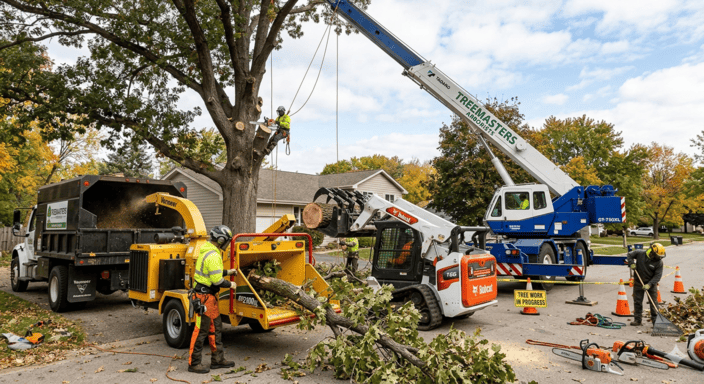
Professional tree removal requires specialized equipment — arborists use chainsaws, rigging systems, and heavy machinery to safely fell, section, and clear trees of all sizes. This guide covers every major category of gear used on the job.
Professional tree removal services use purpose-built equipment to safely dismantle trees of any size, in any location.
The right tools determine whether a job is completed efficiently and without damage to surrounding structures. Below is a comprehensive breakdown of the equipment that defines the trade.
1. Cutting Equipment
Chainsaws
The chainsaw is the primary cutting tool in tree removal. Professionals use gas-powered, battery-powered, and hydraulic models depending on the job scope.
- Gas-powered chainsaws — High torque, ideal for large-diameter trunks and heavy felling work. Common brands include Stihl, Husqvarna, and Echo.
- Battery-powered chainsaws — Quieter and lower-emission; used in residential areas with noise restrictions.
- Pole saws — Extended-reach chainsaws used for limbing high branches without climbing.
Hand Saws and Folding Saws
Used for precision cuts in tight spaces where chainsaw access is limited. Arborists carry folding pruning saws as part of their standard climbing kit.
2. Climbing and Access Equipment
Safe access to the tree canopy is a prerequisite for controlled removal.
Climbing Gear
- Saddle (harness) — A specialized arborist harness that distributes weight comfortably during extended climbing sessions.
- Climbing ropes — Double-braid or kernmantle ropes rated for arborist use, typically 12–13mm in diameter.
- Ascenders and descenders — Mechanical devices that allow controlled vertical movement along the rope.
- Carabiners and pulleys — Load-rated connectors used throughout the rigging system.
- Spurs (gaffs) — Steel spikes strapped to the boots used to climb non-climbable trees destined for removal.
Aerial Lift Equipment
- Bucket trucks (aerial work platforms) — Truck-mounted hydraulic lifts that position workers at height without climbing. Essential for roadside and utility line work.
- Spider lifts — Compact, tracked aerial platforms used in confined spaces where bucket trucks cannot reach.
3. Rigging Equipment
Rigging controls where cut sections land, protecting structures and people below.
- Block and tackle systems — Redirect rope forces and provide mechanical advantage for lowering heavy limbs.
- Friction devices (rappel racks, figure-8s) — Allow controlled lowering of sections at a regulated speed.
- Rigging rings and pulleys — High-strength steel rings anchored in the tree to redirect lowering lines.
- Slings and chokers — Webbing or wire rope loops wrapped around cut sections before lowering.
- Speedlines — Horizontal rope systems used to swing sections away from obstacles and land them precisely.
4. Ground Support Equipment
Wood Chippers
Chippers reduce branches and limbs to wood chips on site. Most commercial operations use drum chippers or disc chippers rated for wood up to 6–18 inches in diameter. Towable models are standard equipment on any removal crew.
Log Splitters
Hydraulic log splitters process trunk sections too large for the chipper. They reduce rounds to manageable firewood or debris for haul-off.
Stump Grinders
After felling, the stump remains. Stump grinders use a rotating carbide-tipped wheel to grind the stump below grade — typically 6–12 inches deep. Sizes range from compact walk-behind units to large self-propelled machines for major commercial work.
5. Heavy Machinery
For large-scale removals — storm damage, land clearing, hazard trees — heavy equipment is required.
- Skid steer loaders — Compact and highly maneuverable, used to move logs, clear debris, and operate grapple attachments.
- Excavators with grapple attachments — Used for directional felling, whole-tree removal, and debris piling.
- Log loaders — Crane-equipped trucks designed to lift and stack large trunk sections onto trailers for haul-off.
- Dump trucks and trailers — Transport debris, chips, and logs from the site.
6. Personal Protective Equipment (PPE)
Every piece of cutting and rigging equipment is paired with mandatory PPE.
| PPE Item | Protection Provided |
| Chainsaw chaps | Cut-resistant leg protection |
| Climbing helmet with visor | Impact, debris, and face protection |
| Hearing protection | Chainsaw and chipper noise |
| Cut-resistant gloves | Hand protection during cutting and rigging |
| Steel-toed boots | Falling log and tool protection |
| High-visibility vest | Traffic and crew visibility on roadside jobs |
7. Communication and Safety Equipment
Large jobs involve multiple crew members working at different elevations simultaneously.
- Two-way radios — Ground-to-climber communication, critical when visual contact is blocked by canopy.
- Hand signals — Standardized signals used in high-noise environments.
- Traffic control equipment — Cones, signs, and flagging for roadside jobs.
- First aid kits — Job-site first aid including tourniquet systems given the proximity to cutting tools.
8. Specialty Tools and Accessories
- Wedges — Plastic or aluminum felling wedges driven into the backcut to control fall direction.
- Cant hooks and peaveys — Lever tools used to roll and reposition heavy logs on the ground.
- Tree jacks — Hydraulic devices used to push a leaning tree in a controlled fall direction.
- Cable and brace hardware — Used when trees are being preserved but structurally supported; relevant on partial removal jobs.
Summary
Professional tree removal is a systems-based operation. Chainsaws and cutting tools fell and section the wood. Climbing and rigging gear controls how and where sections land.
Ground equipment processes debris and clears the site. Heavy machinery handles large-scale operations.
And PPE protects every crew member throughout. Together, this equipment allows arborists to remove trees safely regardless of size, location, or condition.