
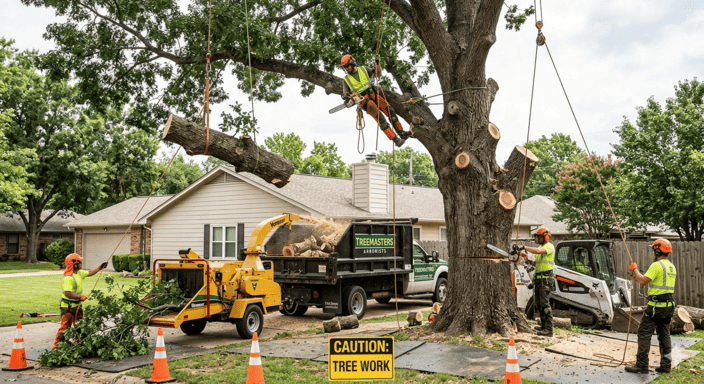
What Is Professional Tree Removal?
Professional tree removal is a structured, multi-phase process in which certified arborists and trained tree care specialists safely dismantle, cut down, and dispose of trees using specialized equipment, established safety protocols, and industry-standard techniques.
Whether a tree is dead, diseased, storm-damaged, structurally hazardous, or simply in the wrong location, licensed tree removal companies follow a repeatable workflow designed to protect property, preserve surrounding landscaping, and ensure the safety of workers and bystanders alike.
This guide answers: How do tree removal professionals work? What equipment is used? How long does tree removal take? What happens to the stump? Read on for the complete, expert-level breakdown.
1. When Is Tree Removal Necessary?
Understanding when a tree actually needs to be removed — rather than treated or trimmed — is the first professional judgment an arborist makes. Not every damaged or unhealthy tree requires full removal.
Common Reasons for Professional Tree Removal
- Dead or dying trees — Trees that have succumbed to disease, drought, or pest infestation pose immediate structural collapse risk.
- Storm or wind damage — Split trunks, broken crowns, or uprooted root systems from severe weather events create emergency hazard conditions.
- Disease and fungal infection — Conditions such as oak wilt, Dutch elm disease, emerald ash borer infestation, or root rot can render a tree structurally compromised and infectious to neighboring trees.
- Structural defects — Codominant stems, included bark, crown imbalance, and trunk cavities reduce a tree’s load-bearing integrity.
- Proximity to structures — Trees overhanging rooftops, power lines, foundations, or driveways present ongoing liability and property damage risk.
- Invasive or nuisance species — Non-native species such as tree of heaven (Ailanthus altissima) or certain eucalyptus varieties may be removed as part of ecosystem management.
- Construction or landscaping projects — Site clearing, foundation work, or planned landscaping redesigns require strategic tree removal.
💡 Key Concept: Tree Preservation First Reputable arborists always evaluate whether pruning, cabling, bracing, or disease treatment can preserve a tree before recommending removal. A Certified ISA Arborist assessment is the gold standard.
2. Step One — Site Assessment and Risk Evaluation
Before any chainsaw starts or equipment arrives, a qualified arborist conducts a thorough on-site risk assessment. This stage determines the entire removal strategy.
What the Arborist Evaluates
Tree Condition Analysis
- Species identification — Determines wood density, brittleness, decay patterns, and limb failure probability.
- Structural integrity assessment — Visual inspection of trunk, bark, branch unions, root flare, and crown density.
- Signs of internal decay — Arborists use a Resistograph (drill-resistance meter), sonic tomography, or a mallet tap test to detect hollow sections.
- Root zone evaluation — Soil compaction, root plate stability, and proximity to pavement or structures.
Site Hazard Mapping
- Overhead utility lines — Proximity to electrical distribution lines requires coordination with the utility company or a line-clearance arborist.
- Surrounding structures — Fences, pools, sheds, driveways, and building walls define the available fall zone.
- Underground utilities — Gas lines, water mains, irrigation systems, and buried cables affect ground equipment movement.
- Slope and drainage — Gradient influences equipment stability, felling direction, and debris flow.
- Access points — Gate width, surface hardness, and overhead clearance dictate which equipment can enter.
Risk Classification
Professional arborists often use the ISA (International Society of Arboriculture) Tree Risk Assessment Qualification (TRAQ) methodology, which classifies trees into risk categories:
| Risk Level | Description |
| Low | Stable tree, low target zone, manageable defects |
| Moderate | Structural defects present, moderate likelihood of failure |
| High | Significant structural failure potential, high-value targets nearby |
| Extreme / Unacceptable | Imminent failure probability; immediate removal warranted |
💡 Pro Tip: Get a Written Assessment Before hiring any tree removal company, request a written hazard assessment and a certificate of insurance. Reputable companies provide both without prompting.
3. Step Two — Permits, Permissions, and Legal Requirements
Tree removal is regulated in many jurisdictions. Skipping the permitting step can result in fines, stop-work orders, or legal liability for property owners and contractors alike.
When Permits Are Required
- Protected trees — Many municipalities designate heritage trees, significant trees, or protected native species that require permits for any trimming or removal.
- Size thresholds — Cities often regulate trees above a certain trunk diameter (DBH — diameter at breast height). Common thresholds range from 4 to 12 inches DBH.
- HOA regulations — Homeowners associations may require written approval before any tree work, regardless of municipal rules.
- Historical or conservation overlays — Properties within historic districts or conservation zones face additional restrictions.
- Easements and right-of-way — Trees on property lines, easements, or public rights-of-way may involve multiple parties.
Who Handles Permitting?
Most professional tree removal companies handle permit applications on behalf of the homeowner as part of their service.
The process typically involves submitting a removal application to the local urban forestry department, planning department, or building authority, along with documentation such as site plans and arborist reports.
4. Step Three — Equipment Setup and Zone Control
Professional tree removal is equipment-intensive. The right machinery is selected based on the tree’s size, location, accessibility, and the removal method required.
Core Equipment Used in Professional Tree Removal
Cutting Equipment
- Chainsaws — Professional-grade saws in various bar lengths (16″ to 36″+) for limbing, sectional cuts, and felling.
- Pole saws — Extended-reach saws for upper canopy work without climbing.
- Reciprocating saws and handsaws — Used for precision cuts in confined spaces.
Aerial Access Equipment
- Aerial lift trucks (bucket trucks) — Hydraulic boom lifts positioned on stable ground allow workers to reach canopy heights of 40–90 feet safely.
- Spider lifts and tracked aerial platforms — Compact tracked lifts that navigate soft terrain, slopes, and narrow access points where wheeled vehicles cannot operate.
- Climbing harness and saddle systems — For trees inaccessible to bucket trucks, certified tree climbers use dynamic rope systems with cambium savers, prussik loops, and friction hitches.
Rigging and Lowering Equipment
- Rigging ropes and slings — High-strength polyester or nylon rigging ropes rated for dynamic loads are used to control sectional lowering.
- Friction devices (Portawraps, Petzl I’D) — Mechanical friction devices allow controlled descent of heavy wood sections.
- Block-and-tackle pulley systems — Used for redirecting loads or removing large sections with mechanical advantage.
- Cranes — For large, confined-access removals, a mobile crane may be positioned to lift entire tree sections over obstacles.
Ground Processing Equipment
- Wood chipper (6″–18″ capacity) — Processes brush and limbs into wood chips for disposal or mulch production.
- Stump grinder — Rotating carbide-tipped cutting wheel grinds stumps and surface roots to below-grade depth (typically 6–12 inches).
- Skid steer loader — Moves large trunk sections, clears debris, and assists with ground-level cleanup.
- Log splitter — Used when firewood processing is part of the removal service.
Zone Control and Safety Setup
Once equipment is staged, the crew establishes a controlled work zone:
- Drop zones — Clearly marked areas where cut material will fall; ground crew keeps clear.
- Traffic control — Cones, barricades, and flaggers used when street or driveway access is affected.
- Personal protective equipment (PPE) — All crew members wear chainsaw chaps, hard hats with face shields, hearing protection, high-visibility vests, and steel-toed boots per ANSI Z133 safety standards.
- Spotter roles — At least one ground crew member acts as dedicated spotter with clear visual communication to the climber or bucket operator.
5. Step Four — The Tree Removal Process (Crown-Down Method)
The actual cutting phase uses one of two primary approaches: the felling method (for open areas with sufficient fall zone) or the sectional/crown-down method (for confined urban and suburban environments).
Most professional removals in developed areas use the sectional method.
Method A: Controlled Felling (Open Areas)
When sufficient clearance exists, a tree can be felled in a single controlled direction:
- Site preparation — Clear a 2x-height escape route perpendicular to the planned fall direction.
- Face notch cut — A directional notch (open-face, Humboldt, or conventional) is made on the fall-side of the trunk. This governs fall direction.
- Back cut — Made on the opposite side, leaving a small hinge of wood. The hinge transfers mechanical force and controls the fall.
- Felling wedges — Plastic or aluminum wedges driven into the back cut to prevent saw pinching and to assist in directing the fall.
- Clear the zone — The feller calls out and moves to the pre-planned escape route as the tree falls.
Method B: Sectional/Crown-Down Removal (Urban Standard)
This is the most common method for residential and commercial tree removal in developed areas.
Phase 1 — Upper Canopy Limbing
- Ascend to crown — Climber ascends via rope and harness or bucket truck to the upper canopy.
- Remove terminal branches first — Small outer branches are cut and dropped or lowered to reduce weight and improve access.
- Progress toward scaffold limbs — Larger structural branches (scaffold limbs) are rigged with lowering ropes before cutting to control descent.
Phase 2 — Structural Limb Removal
- Rigging attachment — A rigging sling or rope is tied above the cut point on each limb.
- Three-cut technique — For large limbs, a pre-cut (undercut to prevent bark tear), relief cut, and final cut are made in sequence to remove limb weight gradually.
- Controlled lowering — Ground crew operates the friction device to lower the limb to the drop zone safely.
- Repeating pattern — Work progresses systematically around the crown, balancing load removal to avoid shifting the tree’s center of gravity unexpectedly.
Phase 3 — Trunk Sectioning
- Work top-down — Once limbs are removed, the trunk is cut in manageable sections from the top down.
- Section length calculation — Section length is determined by weight capacity of the rigging system, proximity to targets, and crew positioning.
- Bore cuts for compression wood — In tension or compression situations, bore cuts (plunge cuts from the center outward) allow controlled release without kickback risk.
- Lowering large rounds — Heavy trunk sections are wrapped with rigging and lowered with friction control or crane lift.
- Final base cut — The last section near the ground is cut as a simple cross-cut, leaving a stump at or near ground level.
💡 Safety Note The sectional method eliminates the need for a large unobstructed fall zone, making it essential for trees near homes, power lines, fences, pools, and other structures. It also greatly reduces impact forces on the ground, protecting underground utilities.
6. Special Removal Scenarios
Emergency Tree Removal
Emergency removals — following storms, wind events, or sudden structural failure — involve additional considerations: unstable root plates, tension/compression in broken limbs, saturated soil reducing equipment traction, and potential hazards from utility contact. Emergency crews prioritize immediate hazard mitigation before full removal proceeds.
Crane-Assisted Tree Removal
Crane removal is used when a tree is in a location inaccessible to conventional rigging — such as trees enclosed in atrium-style landscapes, trees adjacent to pools with no fly zone, or extremely large specimens. A mobile crane is positioned on firm ground, and a certified rigger attaches tag lines and lift slings to pre-cut sections. The crane operator and ground crew communicate via radio throughout the lift sequence.
Trees Near Power Lines
Trees in contact with or within the utility right-of-way require coordination with the utility provider. Line-clearance arborists hold additional certifications (OSHA 1910.269) for work near energized conductors. In some cases, the utility company requires de-energization or insulated protective equipment before tree work can proceed.
Palm Tree Removal
Palm removal differs from broadleaf tree removal due to their fibrous trunk structure and lack of true branches. Climbers use specialized palm spikes rather than spurred climbing. The frond crown is removed first, then the trunk is sectioned using repeated cross-cuts, as the soft fibrous core does not support traditional notch-and-back-cut felling.
7. Step Five — Stump Removal and Root Management
Stump removal is typically a separate service from tree removal and involves its own equipment and decision points.
Stump Grinding (Most Common Method)
Stump grinding is the standard post-removal treatment. A self-propelled or track-mounted stump grinder uses a rotating carbide-tipped cutting wheel to grind the stump and major surface roots to 6–12 inches below grade.
- Equipment positioning — The grinder is maneuvered to center the cutting wheel over the stump.
- Systematic grinding passes — The operator makes overlapping passes across the stump, gradually reducing it to wood chip debris.
- Root flare grinding — Extending the grind radius outward removes major surface roots that could otherwise regrow or create tripping hazards.
- Backfilling — The resulting wood chip and soil mixture is used to fill the cavity, or removed and replaced with topsoil for seeding.
Complete Stump Extraction
For large stumps, root-bound conditions, or areas where replanting or construction will follow, full extraction using an excavator may be preferred over grinding. This removes the entire root ball but requires significant ground disturbance and typically leaves a large void requiring fill material.
Chemical Stump Treatment
Potassium nitrate stump treatment accelerates biological decomposition over 4–6 weeks, making the stump friable enough for manual removal. This low-equipment approach is used for stumps in tight access areas but is not suitable as an emergency or fast-turn solution.
Root Barriers and Sprout Prevention
Some species — such as tree of heaven, black locust, and cottonwood — produce aggressive root sprouts after removal. Herbicide treatment of cut stumps immediately after felling prevents sprout emergence. Root barriers may also be installed to protect foundations or pavement from residual root growth.
8. Step Six — Debris Processing and Site Cleanup
Post-removal cleanup is a significant part of professional tree removal service and is often what separates reputable companies from cut-rate operations.
Wood Processing Options
- Chipping — All brush, small limbs, and small-diameter wood is fed through the chipper and either hauled away or left on-site as mulch at the homeowner’s request.
- Log sectioning for firewood — Larger trunk rounds (typically 4″+ diameter) can be bucked into firewood-length sections and left for the homeowner.
- Full haul-away — All material including chips, rounds, and debris is loaded and transported to a disposal or recycling facility.
Site Restoration
- Raking and blowing — Sawdust, wood chips, small debris, and leaf material are raked and blown from hardscaping, lawn areas, and beds.
- Lawn impact mitigation — Tire ruts or ground disturbance from equipment are addressed with raking, topsoil addition, or overseeding recommendations.
- Ground protection mats — Professional crews use rubber ground protection mats to minimize equipment impact on lawns and soft ground during access.
- Final walkthrough — The crew lead conducts a final site walkthrough with the property owner to confirm satisfactory completion.
9. After Tree Removal — Replanting and Site Planning
Responsible tree removal considers what comes next. A licensed arborist can advise on species selection, soil conditions, and siting for replacement trees.
Soil Recovery
Tree removal disturbs the soil microbiome and mycorrhizal networks that support healthy plant growth. Before replanting, it is advisable to test soil pH and nutrient levels, amend compacted areas with organic matter, and allow 60–90 days for stump grinding residue to begin decomposing before installing new trees over the same area.
Choosing a Replacement Tree
- Right tree, right place — Match mature canopy size to available space, accounting for overhead lines, nearby structures, and root zone spread.
- Native species preference — Native trees provide superior ecological services (wildlife habitat, pollinator support, stormwater management) and typically require less maintenance.
- Disease resistance — Select cultivars with demonstrated resistance to regional diseases and pests, particularly for species replacing a diseased tree.
- Canopy diversity — Avoid replanting a monoculture; diverse species plantings reduce vulnerability to species-specific pests and diseases.
10. How to Hire a Professional Tree Removal Service
Not all tree services are equal. Knowing what to look for protects you from liability, poor workmanship, and unscrupulous contractors.
Credentials to Verify
- ISA Certified Arborist — The International Society of Arboriculture certification is the industry gold standard for arboricultural knowledge and professional ethics.
- State or provincial licensing — Many states require tree service contractors to hold a landscape contractor’s license or arborist license.
- General liability insurance — Minimum $1 million per occurrence for residential work; $2 million for commercial.
- Workers’ compensation insurance — Protects you from liability if a crew member is injured on your property.
- TCIA accreditation — The Tree Care Industry Association accreditation indicates a company has passed independent audits of safety, business practices, and ethical standards.
What a Professional Estimate Should Include
- Written scope of work — Species, trunk diameter, height, removal method, and specific deliverables.
- Stump treatment specification — Grinding depth, root flare radius, and backfill material.
- Debris disposal plan — What is chipped, what is hauled, and what is left.
- Timeline and access requirements — Equipment access needs, crew size, and estimated completion time.
- Permit responsibility — Who applies, who pays for, and who tracks the permit.
11. Tree Removal Cost Factors
Tree removal costs vary widely based on multiple interacting factors. Understanding these helps you evaluate quotes accurately.
Primary Cost Drivers
| Factor | Impact on Cost |
| Tree height and trunk diameter | Higher / larger = more time, more equipment |
| Species and wood density | Dense hardwoods (oak, hickory) take longer to process |
| Location and access difficulty | Backyard, slope, or tight access = higher labor cost |
| Number of lead stems | Each co-dominant stem requires separate rigging |
| Crane requirement | Typically adds $500–$2,500 to base cost |
| Debris volume | Full haul-away costs more than on-site chipping |
| Stump size and accessibility | Larger stumps and pavement proximity increase grinding time |
| Emergency premium | After-hours mobilization typically carries a 25–50% surcharge |
12. Safety Standards and Regulatory Framework
Professional tree removal is governed by a combination of federal, state, and industry safety standards.
Key Standards
- ANSI Z133 — The American National Standards for Arboricultural Operations governs all aspects of professional tree work in the United States, including equipment inspection, PPE requirements, work zone management, and climbing techniques.
- OSHA 29 CFR 1910.266 — Federal logging operations standard applicable to many tree care operations.
- OSHA 1910.269 — Governs utility line clearance work near energized electrical conductors.
- TCIA Electrical Hazard Awareness Program (EHAP) — Required training for any tree care worker operating within proximity of power lines.
💡 Industry Statistic Tree care is consistently ranked among the most dangerous occupations in the United States. Professional companies invest heavily in safety training, equipment maintenance, and crew certification to reduce fatality and injury rates. Hiring unlicensed, uninsured operators dramatically increases the risk of accidents.
Conclusion: What Makes Tree Removal “Professional”?
Professional tree removal is distinguished from amateur or DIY tree cutting by the convergence of four elements: trained and certified personnel, appropriate specialized equipment, adherence to established safety standards, and a systematic, assessment-driven workflow.
From the initial ISA-qualified risk assessment through permit acquisition, equipment staging, crown-down sectional cutting, rigging and lowering, stump grinding, debris processing, and final site restoration — each step serves a defined purpose in a larger system engineered for safety, efficiency, and property protection.
If you are evaluating a tree for potential removal, begin with a consultation from a licensed ISA Certified Arborist. They will assess the tree’s structural condition, recommend the appropriate course of action, and if removal is warranted, execute every step of the process described in this guide with professional-grade precision.
Pingback: Equipment Used in Professional Tree Removal