
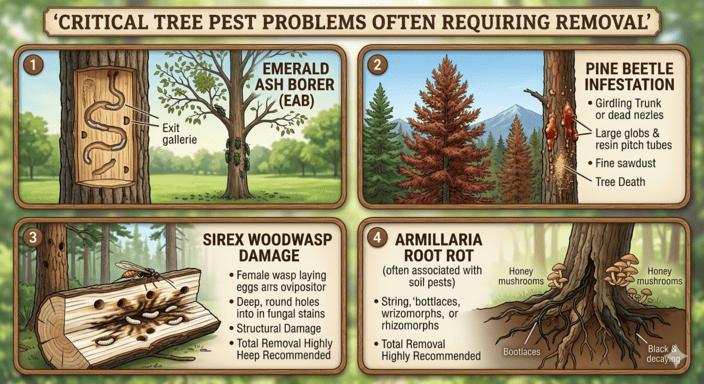
Certain tree pests cause irreversible structural damage that removal resolves permanently.
While many pest infestations can be treated with pesticides, fungicides, or pruning, some insects and diseases compromise a tree’s vascular system, root structure, or overall integrity so severely that removal becomes the only safe and practical solution.
Homeowners, arborists, and property managers in Peoria, Illinois and throughout the region need to recognize these threats early — not just to save the tree if possible, but to protect surrounding trees, structures, and people from a failing specimen.
1. Emerald Ash Borer (EAB)
The emerald ash borer (Agrilus planipennis) is one of the most destructive invasive insects in North America — and one of the most pressing tree threats facing Peoria and the broader Illinois landscape.
Native to Asia, this small metallic-green beetle has killed hundreds of millions of ash trees (Fraxinus spp.) since its discovery in Michigan in 2002, and Illinois has been significantly impacted.
How It Kills
Adult EAB beetles lay eggs in the bark of ash trees. The larvae then bore into the inner bark and phloem, creating winding S-shaped galleries that disrupt the tree’s ability to transport water and nutrients.
Once feeding is extensive, the tree’s canopy begins to die back rapidly — typically from the top down — and the tree cannot recover.
Signs of Infestation
- Thinning or dying canopy, starting at the upper crown
- Serpentine larval galleries visible under loose bark
- D-shaped exit holes (about 3–4 mm wide) in the bark
- Increased woodpecker activity (birds excavate larvae)
- Epicormic sprouting (stress shoots) along the trunk and lower branches
Why Removal Is Often Necessary
By the time visible symptoms appear, EAB has typically been present for two or more years. Systemic insecticide treatments (e.g., emamectin benzoate injections) can protect healthy or lightly infested trees, but trees with more than 50% canopy loss are generally beyond saving.
Dead ash trees also become extremely brittle and hazardous within 1–2 years — a particular concern in Peoria’s residential neighborhoods and parks — making timely removal critical for safety.
2. Asian Longhorned Beetle (ALB)
The Asian longhorned beetle (Anoplophora glabripennis) is a federally regulated pest in the United States and Canada, capable of infesting dozens of hardwood species including maples, elms, birches, willows, and poplars — many of which are common street and shade trees throughout Peoria.
How It Kills
Like EAB, ALB larvae tunnel through the heartwood and sapwood of host trees, disrupting structural integrity and nutrient flow. Unlike EAB, ALB damage occurs deep in the wood, creating large round exit holes (approximately 3/8 inch in diameter).
This internal tunneling weakens the tree’s structure and predisposes limbs and the entire tree to sudden failure.
Signs of Infestation
- Round, dime-sized exit holes in the trunk and branches
- Sawdust-like frass (wood shavings) accumulating at branch crotches and at the base
- Deep oval oviposition (egg-laying) pits in bark
- Sap seeping from wounds
- Premature yellowing of leaves in summer
Also see – Signs a Tree Needs to Be Removed
Why Removal Is Often Necessary
There is currently no effective chemical treatment for established ALB infestations. Regulatory protocols in infested areas mandate the removal and destruction of all host trees within a defined radius — sometimes regardless of apparent health — to prevent further spread. Illinois property owners should report any suspected ALB sightings to the Illinois Department of Agriculture promptly. Infested wood must never be moved off-site without authorization.
3. Dutch Elm Disease (DED)
Dutch elm disease is caused by the fungal pathogens Ophiostoma ulmi and Ophiostoma novo-ulmi, spread by elm bark beetles (Scolytus spp. and Hylurgopinus rufipes).
It has devastated elm populations across North America and Europe since the mid-20th century, and Peoria’s mature elm trees — many planted decades ago along streets and in parks — remain vulnerable.
How It Kills
The fungus colonizes the xylem (water-conducting vessels) of the elm tree.
The tree responds by producing gummy substances to wall off the infection, but this response also blocks its own water supply, causing rapid wilting and dieback known as “flagging.”
The disease can kill a large, healthy elm within a single growing season.
Signs of Infestation
- Sudden wilting and yellowing of leaves on individual branches (“flagging”)
- Brown, olive, or greenish streaking in the sapwood under the bark
- Bark beetle galleries and entry/exit holes in the bark
- Rapid progression from one branch to the whole crown
Why Removal Is Often Necessary
Mildly infected trees with fewer than five percent of their crown affected may be saved through aggressive pruning (cutting well below the streaking) combined with fungicide injections.
However, once infection spreads systemically through the root system — which can happen via root grafts with neighboring elms — removal is the only way to prevent transmission to adjacent trees.
Root barriers and prompt stump grinding are also recommended.
4. Southern Pine Beetle (SPB)
The southern pine beetle (Dendroctonus frontalis) is the most destructive insect pest of pine forests in the southeastern United States.
While Illinois sits at the northern edge of its historical range, SPB is considered an emerging concern in central Illinois, particularly during warmer climate cycles that expand beetle habitat northward toward areas like Peoria.
How It Kills
SPB adults bore through bark to the phloem, where they construct winding, S-shaped egg galleries. They also introduce blue-stain fungi (Ophiostoma spp.) that block the tree’s resin defense system and disrupt water and nutrient transport.
A single pine can be attacked by thousands of beetles simultaneously; the tree typically dies within four to eight weeks of initial attack.
Signs of Infestation
- Reddish-brown “pitch tubes” (masses of resin mixed with frass) on the bark
- Fading crown from green to yellow to russet-red over several weeks
- Blue-stained wood visible under the bark
- Bark beetle galleries under the outer bark
- Infestations tend to “spot” and spread outward to adjacent trees
Why Removal Is Often Necessary
Once SPB has fully girdled a pine, recovery is impossible. Removal of infested trees is the primary recommended management strategy, particularly to slow the outward spread of a beetle spot.
Leaving dead trees standing creates ongoing hazards and can serve as a source of ongoing beetle emergence into neighboring healthy pines.
5. Thousand Cankers Disease (TCD)
Thousand cankers disease is a complex involving the walnut twig beetle (Pityophthorus juglandis) and the fungus Geosmithia morbida. It primarily affects black walnut (Juglans nigra) — a species prized in Illinois both for its timber value and its presence as a native shade tree in Peoria-area landscapes.
How It Kills
Beetles excavate tiny galleries beneath the bark, introducing the fungal pathogen. Each gallery develops into a small canker (dead tissue).
As beetles attack repeatedly over multiple years, thousands of these cankers coalesce, girdling branches and eventually the main stem, cutting off water and nutrient transport.
Signs of Infestation
- Branch dieback beginning in the upper crown
- Small, dark cankers beneath the bark (visible only after peeling)
- Yellow foliage that persists on dead branches (“flagging”)
- Staining of the wood beneath bark at canker sites
- Declining bark texture and color on limbs and stems
Why Removal Is Often Necessary
There are no approved chemical treatments proven effective against TCD in landscape trees once infestation is established.
Heavily infested trees decline over three to ten years, with removal often recommended when the crown is significantly compromised or when the risk of spread to neighboring walnuts is high.
TCD is a regulated pest in Illinois, requiring reporting to state agricultural authorities.
6. Gypsy Moth (Spongy Moth)
Now officially renamed the spongy moth (Lymantria dispar), this invasive pest is one of the most damaging defoliators of hardwood trees in the eastern United States.
Illinois, including the Peoria area, falls within the active monitoring and management zone as the insect’s range continues to expand westward.
How It Kills
Spongy moth caterpillars feed voraciously on foliage, particularly favoring oaks, but also attacking birches, aspens, maples, and many others. A single severe defoliation event rarely kills a healthy tree outright, but repeated defoliations over two to three consecutive years weaken trees dramatically, leaving them vulnerable to secondary stressors — drought, root disease, other pests — that then cause death.
Signs of Infestation
- Complete or near-complete defoliation of the canopy in late spring to early summer
- Tan, spongy egg masses on bark, rocks, and structures
- Large, hairy caterpillars (up to 2 inches) visible on foliage and bark
- Copious frass dropping from the canopy
Why Removal Is Sometimes Necessary
Not all trees attacked by spongy moth require removal. However, trees already stressed from drought, root damage, or disease often die after one or two defoliations.
Trees showing structural failure or that have died should be removed promptly, as dead hardwoods become hazardous relatively quickly.
Aerial and ground-based biological control (Bacillus thuringiensis var. kurstaki, or Btk) is used for prevention and population suppression.
7. Sudden Oak Death (SOD)
Sudden oak death is caused by the water mold Phytophthora ramorum, an oomycete pathogen that has killed millions of oaks and tanoaks along the West Coast.
While its primary range is coastal California and Oregon, the pathogen’s potential to spread to oak-rich regions like central Illinois — where oaks are a defining feature of the native landscape — makes it a disease worth knowing.
How It Kills
P. ramorum infects the bark of susceptible oaks, causing large, bleeding cankers on the trunk (bleeding canker phase) that girdle and kill the tree.
The disease spreads via infected soil, water, and plant material. Many other tree and shrub species act as asymptomatic “spreader hosts” (e.g., bay laurel, rhododendron).
Signs of Infestation
- Dark, reddish-brown to black bleeding cankers on the trunk
- Seeping amber to reddish-black ooze on the bark surface
- Rapid and complete crown death (“sudden” dieback)
- Tiny black fungal fruiting bodies on infected bark
- Clusters of dead trees in high-risk areas
Why Removal Is Often Necessary
Infected oaks with extensive stem cankers typically cannot recover. Removal is recommended to reduce the inoculum load in affected areas.
In regulated zones, removal and disposal protocols must be followed carefully to prevent transport of infected material. Phosphonate fungicide treatments have shown some efficacy in protecting uninfected trees in high-risk areas.
8. Hemlock Woolly Adelgid (HWA)
The hemlock woolly adelgid (Adelges tsugae) is a tiny, aphid-like insect native to East Asia that has devastated eastern hemlock (Tsuga canadensis) populations throughout the eastern United States.
Hemlocks planted as ornamentals in Peoria yards and landscaped properties are susceptible, and with HWA’s range gradually expanding, awareness is increasingly important for Illinois tree owners.
How It Kills
HWA insects attach to the base of hemlock needles and feed on starches stored in the tree.
This feeding disrupts the tree’s ability to produce new growth and eventually causes needle drop, branch dieback, and death — typically within four to ten years of initial infestation without treatment.
Signs of Infestation
- Small, white, woolly egg sacs at the base of needles (visible year-round)
- Graying, dull needles (rather than the healthy deep green of hemlock)
- Needle drop and bare branches
- Progressive crown thinning from the bottom upward
Why Removal Is Often Necessary
Systemic insecticide treatments — particularly soil injections or trunk injections of imidacloprid or dinotefuran — are highly effective when applied early.
However, hemlocks that have lost a significant portion of their canopy (generally more than 50–70%) are unlikely to recover even with treatment, and removal becomes the recommended option.
When to Call a Certified Arborist in the Peoria Area
Any tree showing signs of significant pest damage should be evaluated by a certified arborist (ISA Certified Arborist) before removal decisions are made. Peoria-area arborists familiar with central Illinois pest pressures can assess:
- The percentage of canopy affected
- Structural integrity and fall-zone risk
- Whether treatment is still a viable option
- Regulatory requirements (some pests are quarantine species in Illinois requiring legal reporting)
- Safe removal methods to prevent spread of pest material
Early detection is always the best strategy. Regular inspections — especially for trees known to be susceptible to regional pest threats common in central Illinois — can make the difference between a treatable infestation and a mandatory removal.
Summary Table
| Pest / Disease | Primary Host Trees | Transmission | Treatment Possible? |
| Emerald Ash Borer | Ash (Fraxinus spp.) | Adult beetle flight | Yes, if caught early |
| Asian Longhorned Beetle | Maples, elms, birches | Adult beetle flight | No — removal required |
| Dutch Elm Disease | Elms (Ulmus spp.) | Bark beetles / root grafts | Yes, if caught early |
| Southern Pine Beetle | Pines (Pinus spp.) | Adult beetle flight | No — removal recommended |
| Thousand Cankers Disease | Black walnut | Walnut twig beetle | No known treatment |
| Spongy Moth | Oaks, birches, aspens | Egg mass dispersal | Yes (Btk, biological control) |
| Sudden Oak Death | Oaks, tanoaks | Water, soil, infected plants | Partial (phosphonates) |
| Hemlock Woolly Adelgid | Eastern hemlock | Wind, birds, animals | Yes, if caught early |
Understanding the specific pest threatening your trees — and acting before damage becomes irreversible — is the most effective way to protect your Peoria landscape, your property, and the surrounding ecosystem.