
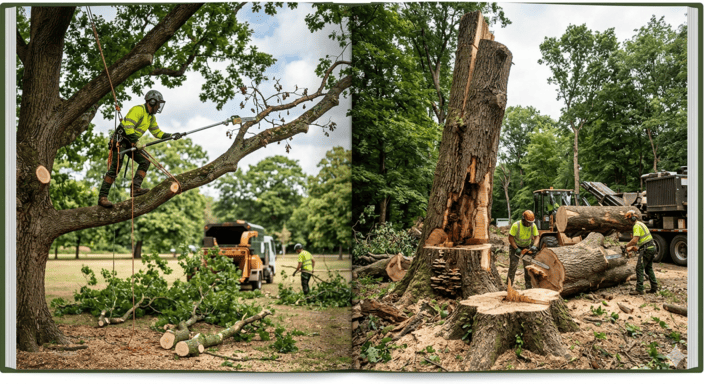
Tree pruning preserves living trees by removing dead, diseased, or overgrown branches to improve health, safety, and appearance.
Tree removal eliminates trees entirely when disease, structural failure, or hazard risk makes preservation impossible or impractical.
Homeowners, arborists, and property managers choose between these two services based on the tree’s condition, location, safety risk, and long-term landscape goals.
Understanding the difference — and knowing when each service is appropriate — can save money, protect property, and keep your landscape thriving for years to come.
What Is Tree Pruning?
Tree pruning is the selective removal of specific branches to benefit the overall health and structure of the tree.
Certified arborists perform pruning using hand saws, loppers, pruning shears, and pole saws — tools designed for precision cuts that minimize stress to the remaining tree tissue.
Crown Management Techniques
Professional pruning typically involves one or more crown management approaches:
- Crown thinning — removes select interior branches to increase light penetration and air circulation without altering the tree’s overall shape.
- Crown lifting — raises the lower canopy by removing branches close to the ground, useful for clearance over roads, walkways, and structures.
- Crown reduction — reduces the overall size of the canopy, often used near power lines or buildings, while maintaining the tree’s natural form.
- Deadwooding — removes dead, dying, or diseased branches that pose a falling hazard or invite pest infestation.
Seasonal Timing for Pruning
The best time to prune most trees is during the dormant season — late fall through early spring — when reduced sap flow limits stress and disease transmission.
Flowering trees are an exception: they are typically pruned immediately after their bloom cycle to avoid removing the following season’s buds.
Emergency pruning for storm-damaged or hazardous limbs should be done immediately, regardless of season.
What Is Tree Removal?
Tree removal is the complete extraction of a tree from the ground, including the stump in most cases. It requires specialized equipment — chainsaws, cranes, wood chippers, and stump grinders — operated by trained tree crews.
Unlike pruning, removal is not a maintenance service; it is a permanent decision made when a tree can no longer be safely preserved.
Felling Techniques and Safety
Tree removal crews use two primary felling methods depending on site constraints. Directional felling — where the tree is dropped in a controlled direction — is used in open areas.
In confined spaces near structures, power lines, or other landscaping, crews perform sectional removal: climbing the tree and cutting it down in sections from the top. Rigging systems and cranes are used to lower heavy sections safely.
Utility Clearance and Infrastructure Concerns
Trees growing near power lines, underground pipes, gas lines, or building foundations present unique removal challenges. Utility clearance must be coordinated with local utility companies before work begins.
Root intrusion into foundations, sewer lines, or driveways is also a factor — the roots of a removed tree may need to be ground or chemically treated to prevent ongoing structural damage.
Tree Health Assessment: The Decision-Making Foundation
The decision between pruning and removal almost always begins with a professional tree health assessment.
A certified arborist evaluates the tree for signs of disease, structural defects, root problems, and pest infestation — then recommends the least invasive intervention that adequately addresses the risk.
Indicators that pruning is sufficient:
- Less than 25–50% of the canopy is dead or diseased
- The main trunk and scaffold branches are structurally sound
- Root system is intact and not significantly compromised
- The tree is a desirable or protected species
- Damage is localized to specific limbs rather than systemic
Indicators that removal is necessary:
- More than 50% of the tree is dead, hollow, or diseased
- The trunk has major cracks, cavities, or severe lean
- Root damage undermines the tree’s structural stability
- The tree is dead and poses an immediate hazard
- Multiple structural failures have occurred after storms
Hazard Assessment and Property Safety
Both pruning and removal are frequently driven by hazard assessment — a formal evaluation of the risk a tree poses to people, structures, and adjacent property. A decayed limb over a driveway may require targeted crown reduction.
A leaning tree with root failure adjacent to a home is likely a removal candidate regardless of how healthy the canopy appears.
Arborists use standardized risk assessment tools — such as ISA’s Tree Risk Assessment Qualification (TRAQ) framework — to assign risk ratings and recommend proportionate responses.
High-risk trees in target zones with high-consequence outcomes (e.g., directly above an occupied dwelling) are typically recommended for removal even when the tree appears healthy overall.
Permits, HOA Rules, and Local Regulations
Regulatory requirements vary significantly between pruning and removal — and between municipalities.
Pruning Permits
Routine pruning on private property rarely requires a permit. However, pruning work on protected or heritage trees, or any crown work that exceeds certain thresholds (typically 25–30% removal in a single season), may require municipal approval. HOA guidelines may also restrict when and how pruning is performed in visible areas.
Removal Permits
Tree removal permits are commonly required by cities and counties, particularly for trees above a certain diameter (often 6–12 inches DBH) or species on protected lists. Some jurisdictions require replacement planting as a condition of removal. Always check local ordinances before removing any significant tree — penalties for unpermitted removal can include substantial fines and mandatory replanting requirements.
Service Cost Comparison
Cost is a practical consideration — though it should never be the sole factor when safety is at stake.
| Service | Typical Range | Key Cost Factors |
| Tree pruning | $150 – $1,500 | Tree size, canopy access, number of cuts, crew time |
| Tree removal | $300 – $5,000+ | Tree height, trunk diameter, location, debris hauling |
| Stump grinding | $75 – $400 | Stump size, root spread, soil access |
| Emergency services | 2–3× standard rate | After-hours, storm response, immediate hazard |
Regular pruning on a maintenance schedule — every 3–5 years for most species — is a cost-effective way to avoid the higher expense of emergency removal. A well-maintained tree rarely becomes a sudden hazard.
Environmental Impact and Canopy Considerations
Trees provide substantial ecological value — carbon sequestration, stormwater absorption, urban heat island mitigation, and wildlife habitat. Pruning preserves all of these functions while improving the tree’s long-term vitality. Removal eliminates them entirely.
When removal is unavoidable, many arborists recommend planting a replacement tree within 12 months to restore lost canopy coverage. Wood from removed trees can also be repurposed as mulch, lumber, or firewood — reducing landfill contribution and giving the tree a secondary use.
Insurance, Liability, and Homeowner Coverage
Both pruning and removal involve significant physical risk — to crew members, your property, and neighboring properties. Always verify that your tree service provider carries general liability insurance and workers’ compensation coverage before work begins. If a crew member is injured on your property and the company lacks workers’ comp, you may be held liable.
Homeowner’s insurance may cover tree removal if a fallen tree damages your home or a covered structure. However, most policies do not cover the removal of a standing hazard tree that hasn’t yet caused damage — another reason proactive pruning and maintenance makes financial sense. Check your policy details and consult your insurer before assuming coverage.
Choosing a Qualified Tree Service Provider
Whether you need pruning or removal, the qualifications of your service provider matter as much as the decision itself. Look for:
- ISA Certified Arborist — The International Society of Arboriculture credential indicates formal training and ongoing education in tree biology and care.
- TCIA Accreditation — The Tree Care Industry Association accredits companies that meet professional safety and business standards.
- State licensing — Requirements vary; verify your state’s tree contractor licensing rules before hiring.
- Proof of insurance — Request a certificate of insurance showing both general liability and workers’ compensation coverage.
- Written estimate — A reputable company provides a detailed written scope of work and pricing before any work begins.
The Right Choice Depends on the Tree
Tree pruning and tree removal are not interchangeable — they serve fundamentally different purposes.
Pruning is a maintenance investment that extends a tree’s life, enhances its appearance, and reduces risk through targeted branch removal. Removal is a last resort, appropriate when a tree’s condition, location, or structural failure makes preservation unsafe or impractical.
The most reliable path to the right decision is a professional assessment by an ISA Certified Arborist who can evaluate the tree’s health, calculate its risk, and recommend the appropriate service — whether that’s a seasonal prune, a full removal, or simply watchful monitoring for another year.
When in doubt, prune first. If the tree can be saved, it almost always should be.