
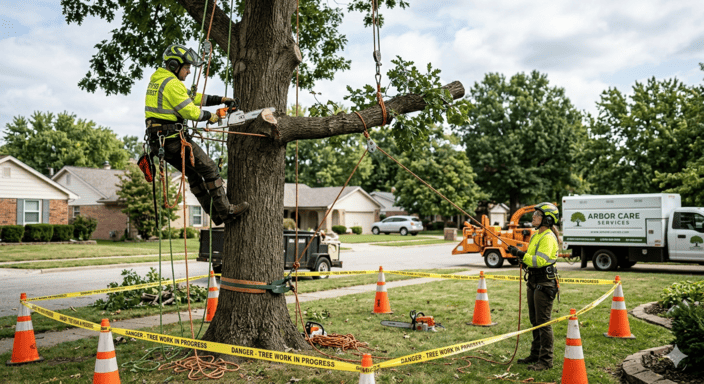
Certified arborists follow a precise, multi-layered set of safety standards to protect workers, bystanders, and property during every tree removal — from initial site assessment through final debris clearing.
Tree removal carries more inherent risk than almost any other landscape operation. Falls, struck-by incidents, and equipment failures injure thousands of workers each year — yet trained arborists reduce that risk dramatically by adhering to established industry and regulatory standards. The following guide walks through each major safety category, explaining not just what arborists do, but why each standard exists.
Pre-Removal Site Assessment and Hazard Identification
Before a single rope is thrown or a chainsaw fired, a qualified arborist conducts a systematic site assessment. This walkthrough evaluates the tree’s structural integrity — checking for decay, included bark, root damage, and lean — then maps the surrounding environment: overhead utilities, structures, foot traffic patterns, and soil conditions that affect fall direction.
ANSI A300 standards (the benchmark for professional tree care in North America) require documenting identifiable defects and assigning a risk rating. This written record drives every subsequent decision, from crew size to whether a crane is necessary.
ISA Best Practice: The International Society of Arboriculture’s Tree Risk Assessment Qualification (TRAQ) methodology establishes a three-level assessment framework — limited visual, basic, and advanced — matched to the likelihood and consequence of failure.
Personal Protective Equipment (PPE) Requirements
OSHA 1910.132 and the Z133 American National Standard mandate specific PPE for tree work. Arborists follow a non-negotiable gear checklist before ascending or operating cutting equipment.
- ✓ Class E hard hat (protects against falling objects and electrical contact)
- ✓ Eye and face protection — safety glasses plus face shield during cutting
- ✓ Hearing protection rated for chainsaw decibel levels (≥ 85 dB exposure)
- ✓ Cut-resistant chainsaw chaps or pants (ASTM F1897 rated)
- ✓ Steel- or composite-toed chainsaw boots with ankle protection
- ✓ Cut-resistant gloves appropriate for the task (climbing vs. ground operations)
- ✓ High-visibility vest for ground crew working near active roadways
No shortcuts are acceptable. Missing one item can mean the difference between a minor incident and a life-altering injury, which is why crew leaders perform PPE checks at the start of every job.
Drop Zone Planning and Work Zone Control
Establishing a secure work zone is one of the most critical — and most frequently overlooked — steps in urban tree removal. ANSI Z133 requires a hazard zone of at least twice the height of the tree in all potential drop directions, keeping unauthorized personnel completely clear.
Standard practice: Ground crews place cones, barrier tape, and posted signage before any cutting begins. On public streets, arborists coordinate lane closures with local authorities and may require a traffic control plan prepared by a certified flagger.
For trees near occupied structures, arborists use rigging systems to control the fall path of large limbs rather than allowing a free-fall drop. This adds time and equipment cost but eliminates unpredictable impacts on rooftops, fences, and vehicles.
“Controlling where the wood lands is just as important as controlling the cut itself — a 400-pound limb in free fall obeys nobody’s plan.”
Climbing and Aerial Work Standards
When climbing is required, arborists follow ANSI Z133 and manufacturer guidelines for all aerial systems. A work positioning system alone is never sufficient — climbers must maintain a redundant fall-arrest system at all times while above ground.
- ✓ All climbing rope rated to ANSI B-44 or equivalent strength standards
- ✓ Saddles (harnesses) inspected before each use for webbing wear and hardware function
- ✓ Carabiners and connectors load-rated and gates tested for security
- ✓ No single anchor point used without a secondary tie-in when limbs are being removed
- ✓ Spike use restricted to removal operations — spikes damage cambium and are prohibited on trees that are to be preserved
- ✓ Aerial lifts operated only by trained, authorized personnel per OSHA 1926.453
Chainsaw Operation and Cutting Techniques
Chainsaw injuries are among the most severe in the industry. Arborists are trained in OSHA 1910.266 and manufacturer-specific safe operating procedures, and they apply specific cutting sequences to avoid the two primary chainsaw hazards: kickback and pinching.
Directional felling — the technique of planning and executing a precise notch and back cut to control the fall direction — is a core competency. A proper open-face notch (70° angle) combined with a calculated back cut leaves a hinge of wood that steers the tree like a rudder. Deviating from this sequence significantly increases the likelihood of an unpredicted fall.
Critical rule: Chainsaws are never operated above shoulder height while standing on the ground, never operated with one hand, and never used to cut directly overhead. All three scenarios dramatically increase kickback risk and reduce control.
Rigging Systems and Mechanical Advantage
When sections of a tree cannot be felled or dropped freely, arborists use rigging systems — combinations of ropes, pulleys, slings, and friction devices — to lower controlled pieces to the ground. This is standard practice in residential and commercial work where space is constrained.
Every rigging component carries a rated working load limit (WLL), and arborists calculate the estimated weight of each piece before attaching rigging to ensure the system is not overloaded. Blocks and carabiners receive a minimum safety factor of 5:1 under ANSI Z133. Rigging anchors (crotches, bollards, or ground-based bollard devices) are assessed for structural soundness before loading.
Communication Protocols and Crew Coordination
On multi-person removal operations, communication failures can be as dangerous as equipment failures. Professional crews establish standardized signals before work begins — particularly between climbers and ground personnel who may be separated by noise, foliage, or distance.
- ✓ Pre-job briefing covers the full removal plan, assigned roles, and emergency procedures
- ✓ Clear verbal and hand signals agreed upon before the first cut
- ✓ Two-way radios used on large or noisy operations
- ✓ A designated safety officer has authority to halt work if conditions change
- ✓ Ground crew never positioned under or near the climber’s work zone
Utility Line Proximity and Electrical Hazard Protocols
Trees growing into or near electrical lines require a separate layer of compliance. OSHA 1910.269 establishes minimum approach distances based on line voltage, and most jurisdictions require coordination with the utility company before work begins on trees within striking distance of energized conductors.
Unless the arborist holds a specific “line-clearance arborist” qualification, work within ten feet of energized lines must be performed only after the utility deenergizes and grounds the lines or installs insulating covers. Treating all lines as energized — regardless of appearance — is a foundational rule.
Industry standard: ANSI A300 Part 7 provides specific guidance for utility line clearance operations, separate from standard removal work, reflecting the additional risk and regulatory complexity involved.
Equipment Inspection and Maintenance Standards
Arborists inspect all equipment before each use, following manufacturer checklists and OSHA requirements. Chainsaws receive daily pre-start checks covering chain tension, bar condition, chain brake function, and throttle lockout. Climbing gear is subjected to a hands-on inspection for cuts, chemical contamination, heat damage, and hardware deformation.
Any equipment that fails inspection is tagged out of service immediately — it is never “used one more time” and repaired later. Maintaining inspection logs is a professional standard among ISA-certified arborists and is increasingly required by liability insurers and commercial clients.
Emergency Action Planning and First Aid Readiness
Every professional crew operates with a written Emergency Action Plan (EAP) for the job site. The EAP identifies the nearest hospital, the site address for emergency dispatchers, and who is responsible for calling emergency services. At least one crew member holds current first aid and CPR certification.
For aerial operations, a “rescue plan” is a formal requirement under ANSI Z133 — the crew must be able to retrieve an incapacitated climber from height before rescuers arrive. This is rehearsed, not improvised, because a suspended worker can lose consciousness from suspension trauma within minutes.
Suspension trauma: A climber rendered unconscious while suspended in a harness faces a life-threatening circulatory condition. Crews are trained to lower the victim to a semi-standing position immediately rather than waiting for EMS.
Post-Removal Site Cleanup and Final Inspection
Safety obligations do not end when the last piece hits the ground. Arborists clear all debris from the work zone, inspect for any remaining hazards (exposed roots, stump trip hazards, ground disturbance near foundations), and restore traffic control devices before leaving. A final walkthrough confirms the site is safe for public access.
Stump grinding — often performed as a separate operation — carries its own PPE and bystander clearance requirements, as rotating carbide teeth can project debris at high velocity over a significant distance.
Hiring a certified, insured arborist is not simply about credentials — it means engaging someone who has formally committed to this framework of standards. When requesting tree removal services, ask to see ISA certification, proof of ANSI Z133 compliance training, and a current certificate of insurance. These documents are the clearest signal that safety standards will be followed from assessment to final cleanup.
Tags: ANSI Z133 · ISA certification · chainsaw safety · climbing standards · utility clearance · PPE · rigging systems · tree risk assessment
Also check How Professional Tree Removal Works