
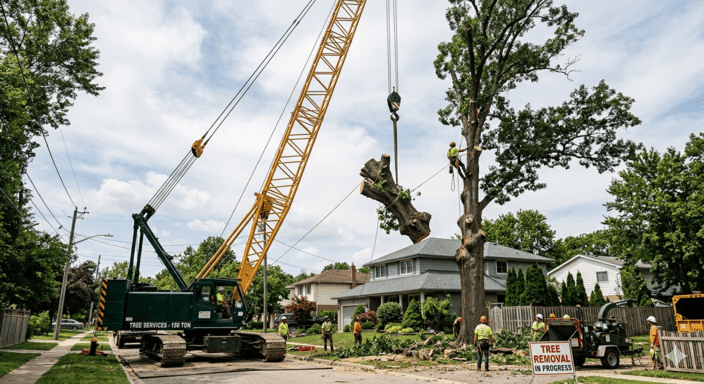
Tree removal requires a crane when the size, location, or structural condition of a tree makes conventional ground-based cutting and rigging methods unsafe or impossible. While most tree removals can be handled with chainsaws, ropes, and a bucket truck, certain situations demand heavy lifting — literally. For homeowners in Peoria, Illinois, understanding when a crane is necessary can help with planning, budgeting, and ensuring the job gets done safely.
Why Standard Tree Removal Sometimes Falls Short
Most arborists prefer ground-based removal: climbers ascend the tree, cut it in sections from the top down, and lower each piece with ropes. It’s cost-effective and works well for trees in open yards with clear drop zones. But this method has real limitations. When a tree is massive, structurally compromised, or wedged into a tight or high-risk space, traditional techniques can put workers, structures, and bystanders in danger. That’s where crane-assisted removal becomes not just an option — but a necessity.
Signs That Your Tree Removal Needs a Crane
1. The Tree Is Exceptionally Large
Trees that exceed 80–100 feet in height or have trunk diameters greater than 36 inches often can’t be safely sectioned and lowered by hand. The sheer weight of each cut section — which can be several tons — makes rope rigging impractical. A crane can lift entire sections cleanly in a single controlled motion. Peoria’s mature urban tree canopy, which includes towering oaks, silver maples, and cottonwoods, frequently produces candidates for crane removal.
2. The Tree Is Dead, Diseased, or Structurally Compromised
A dead or dying tree is unpredictable. Limbs can fail without warning, and a climber working inside the canopy of a decayed tree is at serious risk. In these situations, a crane eliminates the need for anyone to climb the tree at all — the operator can direct sections to be cut and extracted from the safety of the ground. Illinois has seen increased tree stress in recent years due to the emerald ash borer, making structurally compromised removals more common across the region.
3. The Tree Is Located in a Tight or High-Risk Space
Trees growing close to homes, power lines, fences, driveways, swimming pools, or outbuildings leave little room for error. In established Peoria neighborhoods like Moss-Bradley or the Bluff District — where older homes sit close together on narrow lots — this is an especially common challenge. A crane allows for precision extraction, lifting each section up and away rather than swinging or dropping it, dramatically reducing the chance of property damage.
4. There’s No Clear Drop Zone
Conventional removal relies on having somewhere for cut sections to fall safely. In densely landscaped yards, urban environments, or properties with limited access, there simply may not be enough open space. A crane bypasses this entirely by lifting debris vertically and placing it in a designated staging area.
5. The Tree Is on a Steep Slope or Inaccessible Terrain
Peoria’s bluff topography — particularly along the Illinois River corridor — means many properties sit on steep hillside terrain. Trees on these slopes present access challenges that make ground-based removal nearly impossible. A crane positioned at the top or base of a bluff can reach trees that no bucket truck or ground crew could safely approach.
The Crane Removal Process: What to Expect
Crane-assisted tree removal is a highly coordinated operation involving an arborist crew, a crane operator, and typically a signal person (rigger) who communicates between them.
Here’s how it typically works:
- Site assessment — An arborist evaluates the tree and determines the rigging plan, cut sequence, and crane placement.
- Crane positioning — The crane is set up on a stable, load-bearing surface. This sometimes requires plywood or steel plates to protect driveways and lawns.
- Rigging the tree — A climber (or the crane itself) attaches a sling or choker cable to a section of the tree before it’s cut.
- Controlled extraction — The arborist makes the cut while the crane holds tension, then the crane swings the section away and lowers it to a staging area.
- Stump grinding — Once the tree is fully removed, the stump is typically ground down separately.
The entire process for a large tree can take anywhere from a few hours to a full day, depending on complexity.
How Much Does Crane Tree Removal Cost in Peoria?
Crane removal is significantly more expensive than standard tree work. Typical costs in the Peoria, Illinois area include:
- Crane rental: $200–$600+ per hour, with most jobs requiring 4–8 hours minimum
- Arborist crew: $1,500–$5,000+ depending on tree size and difficulty
- Total project cost: Often ranges from $3,000 to $10,000 or more for large, complex removals
While that figure may seem steep, it’s worth weighing against the cost of structural damage to a home or the liability of a removal job gone wrong. In many cases, crane removal is the cheaper option when you factor in risk.
Permits and Utility Coordination in Peoria
The City of Peoria may require permits for tree removal, especially for trees above a certain diameter or located within the public right-of-way. When a crane is involved, additional considerations apply:
- Street closures or traffic control may be needed if the crane must operate from a public road — something that requires coordination with the City of Peoria Public Works Department.
- Ameren Illinois, the local utility provider, may need to temporarily de-energize power lines near the work zone.
- HOA approval may be required in planned communities and subdivisions throughout the Peoria area.
Your arborist should handle most of this coordination, but it’s smart to ask upfront so there are no delays on the day of removal.
Choosing the Right Arborist in Peoria for Crane Work
Not every tree service has experience with crane-assisted removal. When evaluating Peoria-area companies, look for:
- ISA (International Society of Arboriculture) certification
- Proof of liability insurance — crane work carries elevated risk, so coverage limits should be high
- Experience with crane coordination — ask how many crane removals they’ve completed
- Local references and reviews from Peoria homeowners specific to complex removals
- A detailed written estimate that covers crane rental, crew, cleanup, and stump grinding
Avoid any company that quotes crane work unusually cheap without a clear explanation — cutting corners on safety equipment or insurance is a major red flag anywhere, but particularly so when working in tight urban neighborhoods.
Final Thoughts
Crane tree removal is an engineering feat that combines arboricultural expertise with heavy equipment operation. For Peoria homeowners dealing with a large, storm-damaged, or awkwardly situated tree, it’s often the safest and most property-protective solution available. If you have a tree that needs to come down and you’re unsure whether a crane is warranted, consult a certified local arborist for an assessment. The upfront investment is almost always worth the peace of mind.
Also check Equipment Used in Professional Tree Removal