
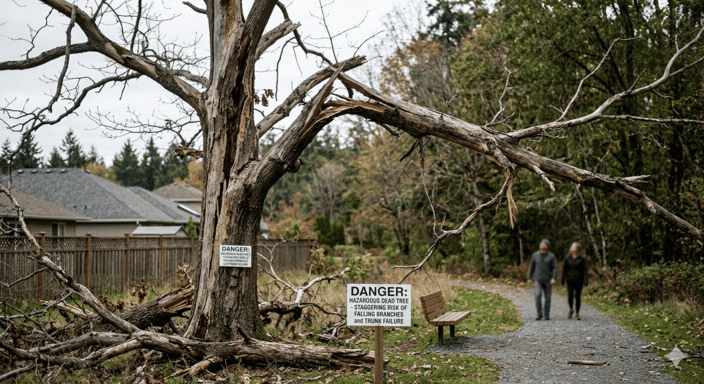
Dead and dying trees pose serious risks to people, property, and surrounding landscapes. Homeowners who ignore declining trees expose themselves to preventable injury, costly property damage, and legal liability. Understanding the warning signs and hazards of unhealthy trees helps you take action before a problem becomes a disaster — especially in areas like Peoria, Illinois, where severe storms and seasonal ice loading routinely test the structural integrity of older trees.
Structural Failure Happens Without Warning
Dead trees lose their structural integrity rapidly once the wood begins to decay. Fungi, bacteria, and insects break down the cellulose and lignin that give wood its tensile strength, leaving behind hollowed trunks and brittle branches that can fail under their own weight — even on calm days.
A structurally compromised tree doesn’t need a storm to fall. Internal rot can progress for years without showing visible signs on the outside, meaning a tree that looks “mostly okay” may already be structurally unsound at its core. In the Illinois River Valley region, where clay-heavy soils can shift during freeze-thaw cycles, root systems in weakened trees are especially prone to heaving and destabilization.
Falling Limbs Are a Leading Cause of Tree-Related Injuries
Deadwood — branches that have died but remain attached — is among the most unpredictable hazards in any yard or green space. Unlike live wood, deadwood doesn’t flex under wind pressure. It snaps. These falling limbs, sometimes called “widow makers,” can weigh hundreds of pounds and drop without the warning signs a visibly swaying tree might provide.
The danger is compounded when dead limbs hang over:
- Driveways and parking areas
- Children’s play equipment
- Patios, decks, and outdoor gathering spaces
- Neighboring properties
Peoria parks and residential neighborhoods with mature oak, elm, and ash trees — many of which have been impacted by diseases like oak wilt or the emerald ash borer — face an elevated risk of unexpected limb failure.
Root Decay Destabilizes the Entire Tree
A tree’s health starts underground. Root rot, caused by soil-borne pathogens like Armillaria (honey fungus) and Phytophthora, quietly destroys the anchor system holding a tree upright. By the time above-ground symptoms appear — wilting, yellowing leaves, fungal growth at the base — the root system may already be severely compromised.
Trees suffering from root decay are at high risk of uprooting completely during wind events, falling whole rather than losing individual limbs. This dramatically increases the danger zone, as a falling tree can extend far beyond what most homeowners anticipate.
Dead Trees Attract Hazardous Pests and Disease
A dying tree becomes a magnet for destructive insects. Bark beetles, wood borers, and carpenter ants colonize weakened trees, accelerating decay and creating galleries throughout the trunk and branches. What’s more concerning is that these populations can migrate — spreading to neighboring healthy trees and creating a cascading die-off.
In central Illinois, the emerald ash borer has already devastated large portions of the ash tree population. A dead or dying ash left standing doesn’t just pose a falling hazard — it functions as a reservoir that allows the pest to spread further into the urban canopy. Proactive removal protects not just your property, but the broader tree health of your neighborhood.
Property Damage and Liability Exposure Are Real
When a dead or dying tree falls on a structure, vehicle, or utility line, the financial consequences can be severe. Homeowner’s insurance may cover damage from “sudden” tree failures, but insurers increasingly scrutinize whether the tree owner knew — or should have known — about the tree’s deteriorating condition.
If a professional arborist, a neighbor, or a municipal notice has flagged a hazardous tree on your property and you fail to act, you may bear full liability for any resulting damage — including damage to adjacent properties. Peoria homeowners should be aware that the City of Peoria has ordinances related to hazardous trees on private property, and nuisance trees can become a code enforcement matter if left unaddressed.
Fire Risk Increases Significantly with Dead Wood
Dead wood is profoundly more flammable than living tissue. Living trees contain significant moisture that acts as a natural fire suppressant. Dead trees, by contrast, dry out completely and ignite readily. During dry Illinois summers, a large dead tree in close proximity to a structure represents a meaningful fire hazard — particularly if dead branches overhang a roof or wooden fence line.
This risk extends beyond open-flame events. Lightning strikes disproportionately ignite dead trees, and a single strike on a dry, standing snag can produce embers that travel to nearby structures.
Warning Signs a Tree May Be Dead or Dying
Knowing what to look for can help you act before a tree becomes a hazard. Key indicators include:
Bark and trunk:
- Large sections of bark sloughing or falling off
- Deep cracks or splits in the trunk
- Soft, spongy wood at the base
- Visible fungal conks (shelf mushrooms) growing on the trunk or roots
Branches and canopy:
- Significant portions of the canopy with no leaf growth in season
- Branches that snap rather than bend
- Hanging or broken branches suspended in the canopy (“widow makers”)
Roots and soil:
- Visible root damage or decay at the base
- Leaning that has developed suddenly or progressively worsened
- Soil heaving or cracking on one side of the tree
If you notice several of these signs on a tree near your home in the Peoria area, consulting a certified arborist is the safest course of action.
When to Remove vs. Monitor
Not every declining tree requires immediate removal. A certified arborist can assess whether a tree can be treated, monitored, or must come down. Factors that typically push toward removal include:
- The tree is more than 50% dead or structurally compromised
- Decay or damage is located in the trunk rather than peripheral branches
- The tree’s fall zone includes a structure, utility line, or high-traffic area
- The species is known to fail without warning (such as silver maple or Bradford pear)
In lower-risk settings — such as a partially declining tree at the edge of a wooded lot far from any structure — a “hazard tree management” approach may be appropriate, with regular monitoring rather than immediate felling.
The Bottom Line
Dead and dying trees are not simply an eyesore — they are active structural hazards that carry real consequences for safety, property, and legal liability. The longer a hazardous tree is left unaddressed, the greater the risk it poses. Whether you’re a homeowner in Peoria’s established neighborhoods or managing a larger rural property along the Illinois River corridor, proactive tree assessment is one of the most practical steps you can take to protect what matters most.
When in doubt, have a certified arborist evaluate your trees. The cost of a professional inspection is a fraction of what a fallen tree can cost — in repairs, injuries, or both.